One size doesn’t fit all

Some time ago I had a conversation with a parent of a child with an ASD diagnosis about the use of public care for both respite and therapeutic purposes, particularly when there has been violent and abusive behaviour towards parents present. Since then we have corresponded from time to time as media interest or legislative procedures have bobbed up and down.

The issue which initially brought us together was with regard to the need for specific understanding of the different and differing needs of neurologically atypical children and young people. We were concerned about a “One size fits all” approach in many aspects of support for families, and a shortage of specific training in neurological conditions for many engaging with families regularly in their work. We acknowledged that some conditions (such as PDA) had only recently been identified, but that other diagnoses were well known and well documented, so that there seemed little excuse for ignorance about the effects on mood and mental health, learning and employment opportunities, behaviour and offending. This parent had undertaken significant research into the diagnosis, communication with family, documentation and support for children and young people with ASD, and found that many went undiagnosed or their specific needs unrecognised, despite their over-representation within care and the juvenile justice system. Continue reading

1 Comment

Filed under Discussion

Oh! Can I have a quick word?

It started off almost as a throw away comment, made its way into a conference presentation, and now seems to have become a thing. So its definitely going in my book under “things not to say to parents”!

What we hear depends so much on where we are at that moment (emotionally and geographically), why we’re there, past experience, how distracted we are – before we even start on tone of voice, inflection or status of the person speaking. I thought I’d ask friends and family what they assumed if they heard that request. A quick straw poll came up wth the following responses and variations on the themes:

  • Something must be very wrong
  • Oh God, what I have I done now?
  • It’s almost certainly not going to be quick!
  • This is going to be bad news
  • No, I absolutely don’t have time

I have every confidence that the person making the statement originally had the very best intentions, perhaps wanted to appear casual, to put someone at their ease even. That might work for some people (or there again, judging by the responses above, it might not).

If you are used to being called in to school for a child’s behaviour, if the police are regular visitors at  your home, or if you are hiding something that is happening in your family because you are too ashamed to talk about it – child to parent violence for instance, then its not going to go so well. If we want to really work in partnership with parents, to help people feel valued and not ashamed, to encourage people to be open with us, then we need to choose our words extraordinarily carefully. Not just with comments like this one of course, but everything we say. We won’t always get it right. But if we start to think about it then that must be a good thing, yes?

(Bizarrely this article appeared in the Guardian this week, and seems to demonstrate clearly every possible way of alienating parents and preventing working in partnership!)

Leave a comment

Filed under Discussion

Soaring number of children being taken into care for abusing and beating up parents

This was a headline in the Sun newspaper last weekend, in an article by Michael Hamilton. Freedom of Information requests to 149 councils in England resulted in a figure of 62 children, ranging in age from 10 upwards, removed from their homes in 2015 by just 16 authorities. Some authorities refused to answer, citing data protection laws. The article lists the authorities which did respond and the relevant number in each case. The corresponding number for 2014 was 49. There are no other details, other than comments from an NSPCC spokesperson, recognising the impact of trauma on children’s behaviour and highlighting the need for help and support for families. Please assume my usual comments about the reliability of statistics such as these! Continue reading

4 Comments

Filed under Discussion, news reports

Learning about feelings, building resilience with Cyril Squirrel

Cyril Squirrel Finds Out About Love, by Jane Evans (2016) Jessica Kingsley Publishers.

I was very pleased to be asked to review this book, having first met Jane around the time she was starting to write the first of her books for young children. Jane is a trauma parenting specialist with many years experience in the field of domestic violence, fostering and, most recently, work on the brain responses to trauma. We met at the Oxford APV conference, and of course the experience of early trauma does seem to be a factor for many families where there is child to parent violence. If we can get things right early on with resources such as these books, then we can hopefully help parents create a healthier and more resilient environment for their children.

IMG_4448


Continue reading

Leave a comment

Filed under Book review

CPV: working across other communities

In one of those serendipitous ways this topic has cropped up in a lot of separate conversations recently so I thought I’d gather a few thoughts together.

I am indebted to Carole Williams, Parenting Officer in Ipswich and with many years experience as a Who’s in Charge? trainer, for her help in putting this piece together; and also to Cathy Press, Who’s in Charge? trainer, therapist and DA consultant with Awareness Matters, for her input. Although these comments come particularly from experience of working in group situations, many are relevant to one-to-one work also. Continue reading

Leave a comment

Filed under Discussion

A parent campaigns for child to parent violence to be recognised in law.

A parent campaigning for recognition of child to parent violence and abuse within the legal system in the state of Florida, recently posted this video on youtube.


I am told that the animation was made with the full knowledge of the young person concerned, and that her mother, Heather, is keen that as many people view it and hear her story as possible. She would also like to hear from people who recognise her position and would like to join with her in lobbying the state legislature. Continue reading

4 Comments

Filed under Discussion, Film

France responds to “tyrannical children”

I was approached recently by a journalist covering the issue of child to parent violence and abuse in France – where the term “tyrannical child” is being used to describe the issue, for the International Business Times. You can read the article here.

It is always encouraging to hear about new work starting around the world. In France the specialist help that is being developed is located within health services. At the moment the only service is in Montpellier but after an initial trial, using a combination of CBT and NVR techniques and a support group for parents,  this to be rolled out across the rest of the country soon.

Leave a comment

Filed under projects

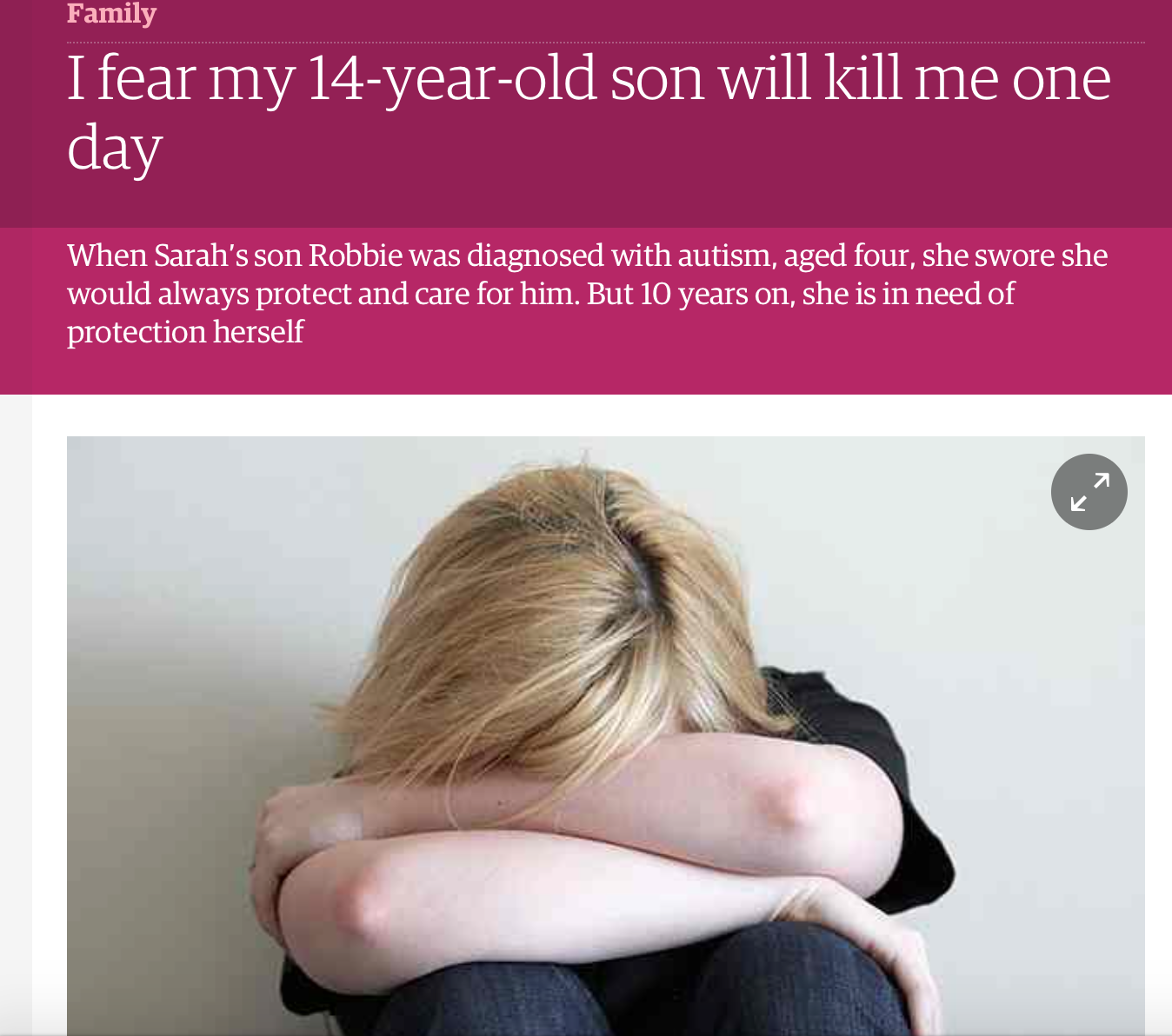
I fear my son will kill me one day

This headline and the accompanying piece in the Family section of the Guardian last Saturday could not fail to shock those who came across it: a mother describing the terrible physical abuse she experiences at the hands of her teenage son.

Screen Shot 2016-07-11 at 12.32.36


“Sarah” has found it almost impossible to admit that she is scared of her son, and yet when she first asked for help was told that it was unlikely she would get any – because he was loved and not in any danger. This reflects the prevailing story: that in a culture that separates children’s and adults’ needs and services, and focuses on the rescuing of children from danger, we fail to recognise the centrality of relationships in family lives, whether in their fragility of care or their strength to bring healing. Feeling undermined by professionals as much as by strangers and increasingly isolated at a time when their need for support on every level increases, the family is now offered 2 nights respite care every six weeks. Continue reading

4 Comments

Filed under Discussion, news reports

Children who have experienced loss and trauma

I was very proud recently to be asked to contribute to an educational programme developed by the University of Sunderland.

CELT picture


Children who have Experienced Loss and Trauma is an online training programme consisting of a series of short modules, each of which can be completed over a period of ten weeks, focussing on this area of work. My module, An Introduction to Child to Parent Violence, is available from mid July, and more information can be found on the CELT website.

The programme addresses the need for easily accessible CPD and introductory training for a variety of professionals and carers, and anyone interested in learning more.

5 Comments

Filed under Training opportunities

Learning Links funding secured for NVR

Some good news at a time when we are becoming used to hearing of funding being cut. Congratulations are due to Learning Links, a charity based in the south east of England, who announced last week that they have secured funding from Children in Need which will enable them to continue to run their Circles of Support programme for a further two years. Circles of Support consists of Non Violent Resistance (NVR) sessions with additional parent and child relationship building activities. The target is to reach and support parents and carers of 90 children aged between 5 and 17 years.

The Business Development Manager, Clare Mussell  said: “Our NVR courses have been absolutely crucial in supporting families who are living with child to parent violence. It is crucial that families get support to alleviate stress and to ensure that children achieve the best outcomes in life. The BBC Children in Need funding will enable us to deliver NVR and build bridges between parent and child and bring the family back together”.

Learning Links has offices in both Portsmouth and the Isle of Wight, and details of how to contact them can be found here.

1 Comment

Filed under news reports, projects