Listening: the most important thing?

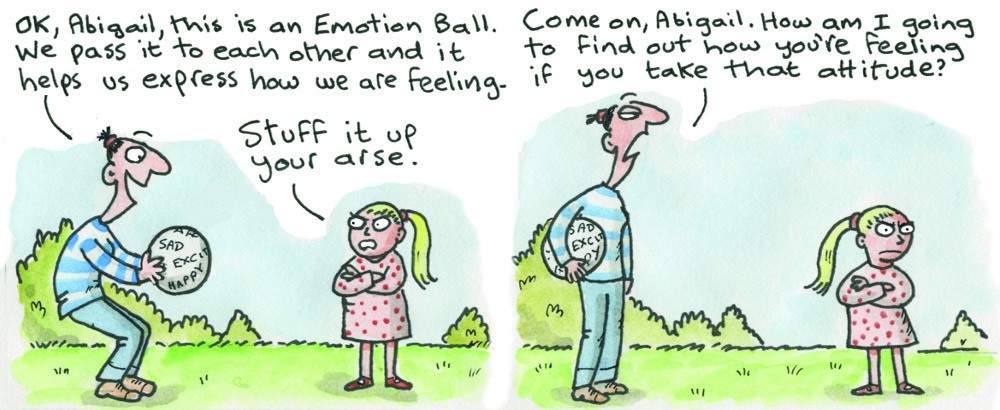
Time and time again, when I ask parents what is the most important thing in the help that they have received, I am told that it is when someone has listened. Really listened. So when I saw this Clare in the Community cartoon strip from Harry Venning my first impulse was to contact him for permission to use it to illustrate a blog post.

In truth though, it’s hard to know what can be added to make the point any better or stronger! So I leave you with it as it stands. Enjoy – and listen!

(Harry publishes a calendar each year with a collection of  the best strips. Do check it out!)

clare itC

1 Comment

Filed under Discussion

A watershed for PDA awareness: My child is not naughty!

There has been rather an emphasis on the impact of domestic violence or trauma on here recently, and so I thought it was time to redress the balance and consider the presentation of violence and abuse to parents from children on the Autistic Spectrum. Today I bring you a guest post from Jane Sherwin, who I first met on twitter writing about life with her daughter, Molly. Jane has become something of an expert on the condition, campaigning, blogging, and publishing a book in 2015. Continue reading

3 Comments

Filed under Discussion

The use of section 20 placements in CPV

This post follows on from a small discussion I took part in on twitter on June 2nd, itself emerging from a conference asking Is the Child Protection System Fit for Purpose? #CPConf2015 (Sadly one which I did not attend.) There are numerous write-ups of the conference available on line. The organisers have one here. You can read one from a parent who took part here.

This is about an issue that I would like to understand more as it effects real people (rather than in a theoretical way), and I’m relying on you all to help me: the use of section 20 placements (Children Act 1989) when parents seek support with an abusive child from Children’s Services.  It seems to me that this would be an important part of a tiered response, and yet I hear very negative comments about the implementation.  Through my own experience, through listening to people, particularly on twitter (but also “real life”) I have conjured up a series of statements and questions as a starter for debate. So here goes …. Continue reading

17 Comments

Filed under Discussion, Law

Trauma and resilience conference

Where is our outrage?

Lisa Cherry and Jane Evans hosted an inaugural conference on Trauma, Resilience and Recovery on June 2nd 2015. You can see a short video summarising the conference here.

Their work is concerned with raising awareness of the effects of early trauma and changing the way we work with children and families to take account of this, building an attachment focused and trauma aware society more able to support and heal those impacted by early (and ongoing) adversity. This is an issue that both Jane and Lisa are passionate about, and both speak and write extensively about it. Each has written a summary of the conference on their blog (Jane here and Lisa here).

Some would say this is timely as the National Institute for Health and Care Excellence (NICE), has issued guidelines, currently up for consultation, arguing that health and social care providers should train all key workers in assessing attachment difficulties and parenting quality, for children in – or on the edge of – care. You can read more about this here.

Leave a comment

Filed under conference report

A problem the size of Wales

Two eagerly awaited (by me) reports were published last week, coincidentally, both examining the issue of children’s violence to parents as experienced in Wales.

Beyond the Adoption Order (Wales): Discord and disruption in adoptive families, by Professor Julie Selwyn and Dr Sarah Meakings at the University of Bristol, is an important follow up to the report on adoption disruption in England last year. Very similar findings to the England report were found. All cases of disruption included APV,  typically emerging around the age of 13 years. Experiences of support from agencies, family and friends are examined throughout the process. Extensive recommendations are included at the end. Since the time of the report, Wales has established a National Adoption Service. Continue reading

Leave a comment

Filed under Research

Research round-up

I’m really pleased to let you know that the reports for the Daphne RCPV project are finally completed, and these, along with related resources are now available on their website. These include conference presentations, CPV evaluation framework and tools, self-efficacy questionnaires, toolkits including those for Break4Change and NVR, and the RCPV films: “Defining CPV” and “Project Findings”. The website will be updated twice a year, so do check it out from time to time for new material. Some of these reports are also available in Spanish, Swedish and Bulgarian. Continue reading

Leave a comment

Filed under Research

And the winner is … Everybody Hurts!

Congratulations to Sarah Swift and Everybody Hurts, winners in the Foundation Derbyshire Awards 2015!

Sarah had applied to Foundation Derbyshire for funding to cover costs of books and travel for those attending the support group Everybody Hurts. In a rural area there can be long distances to travel and it can be really difficult to get to events, especially when there might be trouble brewing at home, so every incentive to make it possible is important. The top 12 groups to win funding (as chosen by the Foundation) were then entered into a further round of competition, from which the top 6 received an additional £150 as announced at an event celebrating the good practice of all concerned. Sarah plans to put the unexpected windfall towards advertising costs. Continue reading

Leave a comment

Filed under projects

The Adoption Social: Listening to and supporting each other

One of the particular groups of people I follow on twitter has been the adoption community. Early on in my exploration of children’s violence to parents, and more especially after publication of the report Beyond the Adoption Order, I become aware that families living with children they had adopted were facing sometimes extreme levels of violence and that it often felt different to other forms of CPV. Often times it involved children as young as three or four, and could clearly be linked back to experiences of trauma: neglect, violence, abandonment, multiple placements, and the cutting of familial ties. These were children demonstrating anger, grief, frustration and most of all fear, and – as with all CPV – there was very little being offered in the way of support. A few tentative steps are now being taken in developing therapies and support packages for families, but one of the key things that has enabled people to keep caring, to keep going at all, has been the friendships, advice and care forged online. Continue reading

Leave a comment

Filed under Discussion

Adolescent to parent abuse as a form of DV?

Two recent things of interest from Amanda Holt:

A journal article looking at similarities and differences between adolescent to parent and intimate partner violence; and a seminar addressing this issue at Oxford Brookes University last month. You can hear Amanda and see the slides from this presentation here.


Leave a comment

Filed under publications

“Cases of children abusing their parents has soared by 60% in two years”

People have been much exercised over recent weeks by an apparent huge rise in the number of younger and younger children being involved in serious crime; and bundled in with this is the issue of these children’s violence and abuse towards their parents. Both the Daily Mail and Telegraph published items around this theme, and I saw the same story covered by the website Dad info.

What are we to make of this?

First, we must be cautious about the meaning we ascribe to crime statistics, as to any data. Crime figures have always been affected by reporting behaviour (of both victims and police), societal attitudes (some would like to attribute it to parents giving up their parenting responsibilities to the state), by targeted programmes, categorisation, and also – certainly in the past – by the practice of “manipulation”. The figures, too, come on the back of reported “very large reductions in serious youth violence” in the previous year, reported also by the Youth Justice Board, in January of this year; though there may be some localised variations in this. Scepticism is important, but we need to also acknowledge real changes society, such as an increase in the use of children by gang members seeking to evade the law themselves, or to the impact of different exclusion policies adopted as the picture of school governance changes across the country, which may act to drive up figures of real crime. Continue reading

Leave a comment

Filed under Discussion, news reports