When Rosemary Pate was killed by her son in Florida in 2013, family and friends began a campaign to raise awareness of this form of violence within the family and to provide better protection for families affected. Significantly the campaign included not only pressure for treatment and counselling, but also moves to introduce legislation. Breaking the Cycle Consulting (BTC), a Florida based program, has been ideally placed to develop such services and has recently been working in collaboration with researchers at the University of Central Florida (UCF) to inform the development of legislation. Continue reading
Discussion about CPV going mainstream?
When the Guardian carries two pieces in a weekend alluding to violence and abuse from child to parent, (A letter to my teenage girl who hates me so very much and My ten year old daughter was bullied – is this why she has tantrums?) I think we can safely say that we are beginning to go mainstream.
Neither of these pieces is entirely straightforward – but isn’t that the point? Relationships within families are complex and varied. Violence and abuse has roots in so many different places. The tipping point between normal reaction and abusive behaviour can be hard to identify other than retrospectively. In both cases we see parents who are unimaginably sad for their children and at what is happening in their families, looking for answers and hoping for a better future. Continue reading
Filed under Discussion
Child to Parent Abuse: some new resources for professionals
As a comprehensive introduction to child to parent abuse, and guidance for professionals, a booklet from the North East Hampshire Domestic Abuse Forum and Safer North Hampshire is very a very welcome addition to the shelves. 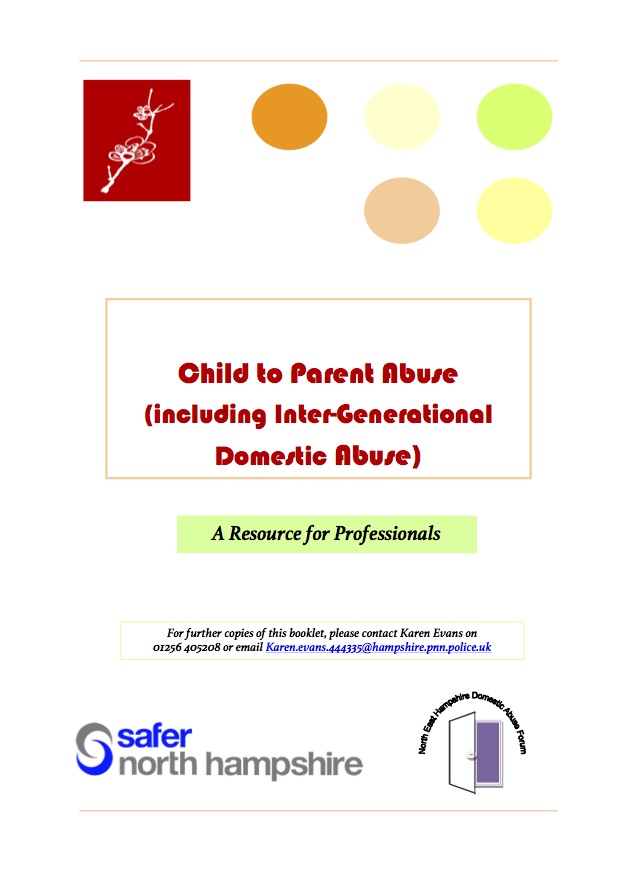 Published in June 2014, it popped up through a google alert just this week. The booklet is downloadable from the North East Hampshire Domestic Abuse Forum website, (information booklet for practitioners about child to parent abuse). Further resources will shortly be available in the form of an eagerly awaited new book, edited by Amanda Holt: Working with Adolescent Violence and Abuse Towards Parents. The book offers information about both well-established approaches and programmes, including theoretical frameworks and toolkits; and examples of innovative practice.
Filed under publications
Non-Violent Resistance, a review of one day training
This post was written for The Adoption Social website by Sarah last week, and I have reposted it here with permission. I know that there are many ‘views’ of this site in respect of NVR, and so I hope it will be useful. Similarly, if you have an interest in adoption matters, The Adoption Social is an important and valuable resource.
Sarah from The Puffin Diaries shares her thoughts on a Non-Violent Resistance course she attended.
Recently my husband and I attended a course based on the practice of NVR, Non-Violent Resistance. This course was hosted by PAC and delivered by Rachael Alymer of Partnership Projects.
The first thing that struck myself, my husband and indeed many others, was that we were a room, full with over thirty people and everyone of us had experienced violence from their child. This in its self had a huge impact on many of us; there was an instant feeling of not being alone. Continue reading
Filed under Training opportunities
Where are the specialist services?
Readers of this blog will be familiar with my dream of mapping specialist services around the country for those experiencing child to parent violence (here). With a small amount of funding secured this undertaking finally began for real in May of this year, working half a day a week. What is being found is telling in a number of ways.
- As expected there is little specialist provision over all.
- Discovering services that are new to me has been difficult. How much more difficult must it be for parents?
- Working out who to approach. In some areas a service is run by a domestic violence organisation, in others through youth offending and some are independent. A single point of contact for referrals / requests is thus absolutely essential.
- Sometimes services are not open to all families. For example, some are only for young people already engaged with the youth offending team.
- Practitioners in local services may not always be familiar with services other organisations are running.
- There is a lot of adaptation of tried and tested programmes to fit local situations (or perhaps the skill set or inclination of the practitioners?)
- Funding issues – there is sometimes a degree of uncertainty as to how long the programme will continue.
Filed under projects
When children kill their parents.
The book currently at the top of my “to read” pile is Kathleen Heide‘s Understanding Parricide. Twenty years on from her first book, Why Kids Kill Parents, this book builds on and develops the understanding from the earlier work. In this comprehensive tome, Heide relies on accounts from the literature and her own significant clinical experience, to answer the questions everyone wants to know: who, how often, what weapons, is it increasing and most of all WHY? Continue reading
Filed under Book review, Discussion
When holidays turn violent
While there are many, many different routes to violence and abuse, we know that for some children and young people, a change in routine can be a real trigger and parents and families must learn to manage this as best they can. Uncertainty, anxiety, sensory overload, loss of control or a fear of abandonment can all bring on violent and destructive behaviour directed towards adults, siblings or property as a child expresses their emotions or seeks to regain some sense of control. Some children will manage a particular event but “collapse” later on. For others, the change itself is sufficient to bring on attempts to escape the pressure. Families with children with ASD diagnoses, FASD, or adoptive parents, amongst others, will be all too familiar with this. It is important that professionals are equally aware and supportive of families in finding solutions. Continue reading
Filed under Discussion
Listening: the most important thing?
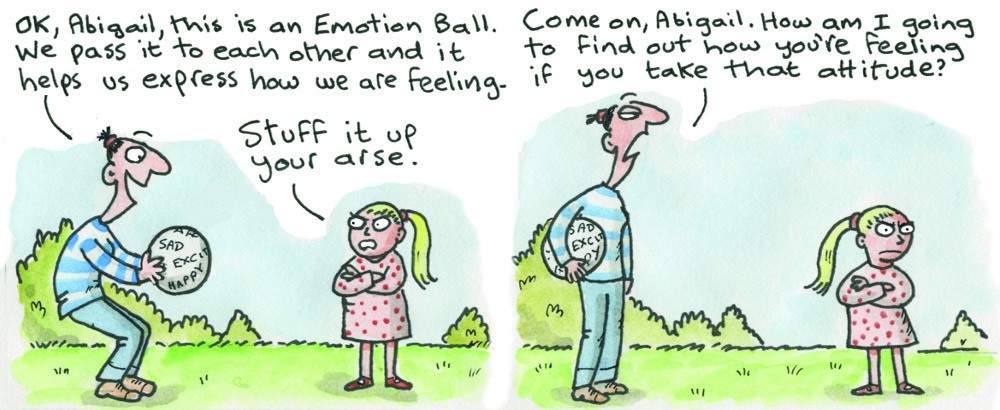
Time and time again, when I ask parents what is the most important thing in the help that they have received, I am told that it is when someone has listened. Really listened. So when I saw this Clare in the Community cartoon strip from Harry Venning my first impulse was to contact him for permission to use it to illustrate a blog post.
In truth though, it’s hard to know what can be added to make the point any better or stronger! So I leave you with it as it stands. Enjoy – and listen!
(Harry publishes a calendar each year with a collection of the best strips. Do check it out!)
Filed under Discussion
A watershed for PDA awareness: My child is not naughty!
There has been rather an emphasis on the impact of domestic violence or trauma on here recently, and so I thought it was time to redress the balance and consider the presentation of violence and abuse to parents from children on the Autistic Spectrum. Today I bring you a guest post from Jane Sherwin, who I first met on twitter writing about life with her daughter, Molly. Jane has become something of an expert on the condition, campaigning, blogging, and publishing a book in 2015. Continue reading
Filed under Discussion
The use of section 20 placements in CPV
This post follows on from a small discussion I took part in on twitter on June 2nd, itself emerging from a conference asking Is the Child Protection System Fit for Purpose? #CPConf2015 (Sadly one which I did not attend.) There are numerous write-ups of the conference available on line. The organisers have one here. You can read one from a parent who took part here.
This is about an issue that I would like to understand more as it effects real people (rather than in a theoretical way), and I’m relying on you all to help me: the use of section 20 placements (Children Act 1989) when parents seek support with an abusive child from Children’s Services. It seems to me that this would be an important part of a tiered response, and yet I hear very negative comments about the implementation. Through my own experience, through listening to people, particularly on twitter (but also “real life”) I have conjured up a series of statements and questions as a starter for debate. So here goes …. Continue reading
Filed under Discussion, Law

 HOLES IN THE WALL