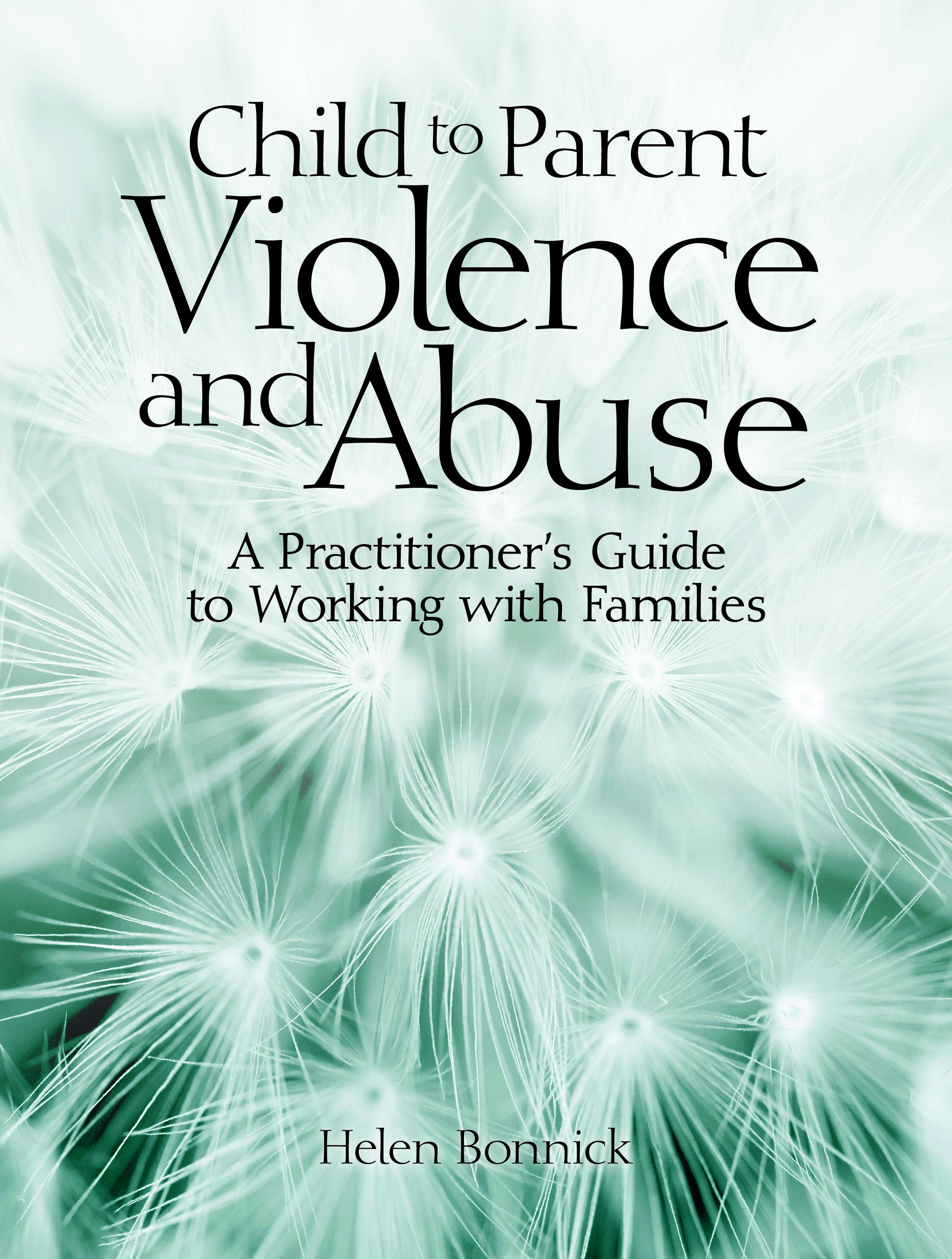
What do you do if you are a parent experiencing violence and abuse from your child but there is no help available where you live? So many parents speak of a lack of understanding from non-specialists, and regular parenting groups that can make the situation worse rather than better. Up until now the only recourse might have been to online message boards, helplines or friends. Now there is a “virtual group” in the shape of a step-by-step guide to understanding behaviours that can hinder or help the restoration of a healthy family relationship. Continue reading
Tag Archives: Child to parent violence
A PhD in Adolescent to Parent Violence?
A double treat today from bits and pieces I picked up last week.
First, the opportunity to study for a PhD in adolescent to parent violence with Amanda Holt, at Roehampton University from this September.
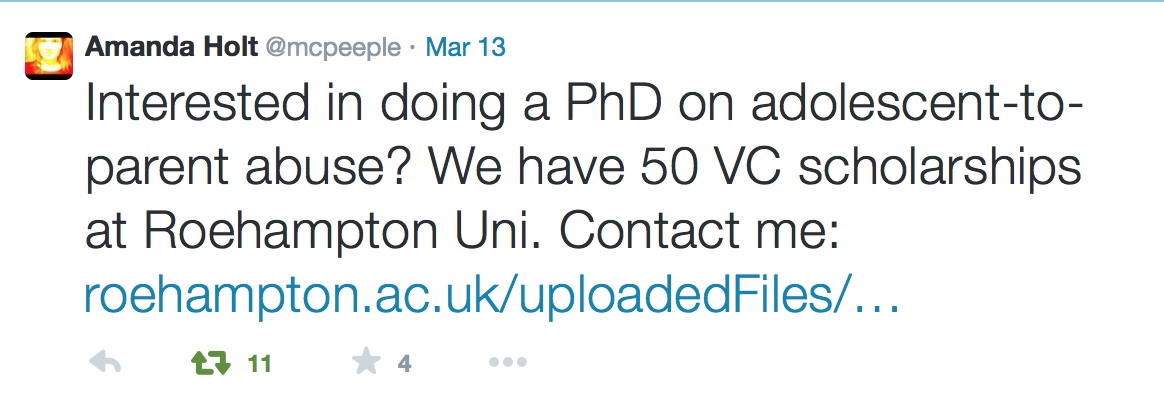
More details on this available here.
Secondly, news that Coronation Street will feature a storyline about child to parent violence later this year.

As soon as I hear more detail about the timing of this I will be sure to let you know!
Filed under news reports, Research
Lazy reporting could not spoil an opportunity to discuss parent abuse
This started off as a weary rant from me today and then changed tone as the day progressed!
While it has been exciting and encouraging to see the increase in coverage of child to parent violence and abuse in the media over the last week, I have been disappointed yet again by the tone of some of the pieces and the apparent laziness of reporting.
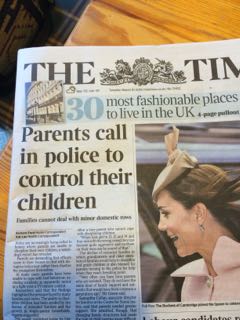
The main headline in the Times, (you may not be able to read the next line, “Families cannot deal with minor domestic rows”) today picks up on the report from Her Majesty’s Inspectorate of Constabulary into the welfare of vulnerable people in police custody, which has held centre stage across the media today. This highlights the often inappropriate use of custody for individuals experiencing poor mental health, or other vulnerabilities, because of a crisis in other support services; and while researchers have said that the findings show pressures faced by many families and carers, and the fact that the police are often used as the agency of last resort, the first example given – thus setting the tone – is of a dispute over a TV remote control. Other examples are given of greater severity of risk and violence. Parents are described as contacting the police because they reach breaking point. But there is no exploration of this issue in a wider way, other than to suggest lone women are finding it particularly difficult to bring up children. Continue reading
Filed under Discussion, news reports, radio and video
A brighter future for families experiencing child to parent violence
Continuing a mini series of interviews about different projects around the country, I have been speaking with Sian Taylor at Wish for a Brighter Future in Bristol.

Wish for a Brighter Future (WISH) has been in operation since 2003, when a small group of Hartcliffe residents identified a need to provide domestic abuse support in their community. WISH worked for many years supporting men, women and children affected by domestic violence and abuse (DVA) within the local community before developing their parent abuse project. They found their understanding and experience of DVA were vital in making the transition from domestic to parent abuse support. While the original expectation was that the work would be with young people, delivering domestic abuse prevention work through education and group work support – and the funding* supported this plan – once the doors opened the organisation was inundated with referrals for parent abuse, and for the last year this has been the sole focus of the work. Continue reading
New Year, New Reading
I have recently been sent links to new and additional published articles in the field of adolescent to parent abuse; and have updated the Reading List page accordingly.
A paper by Caroline Miles and Rachel Condry, Adolescent to parent violence: the police response to parents reporting violence from their children, further develops the discussion arising from the findings of their three-year research project. This paper specifically examines police responses and suggests a way forward that offers support and restorative action for families. (Abstract here.)
Declan Coogan has a paper entitled Responding to Child-to-Parent Violence: Innovative Practices in Child and Adolescent Mental Health, in the Health and Social Work Journal, Special Issue: Child and Adolescent Health. (Abstract here) He considers obstacles in the recognition of, and response to, child to parent violence, and proposes the Non Violent Resistance Programme as a positive way forward.
Sally Donovan’s second book about the experiences of adoptive parenting, The Unofficial Guide, offers a further raw and powerful account of living with children traumatised by earlier life. She offers practical steps and guidance for parents, but the book is well worth reading for anyone involved in the adoption or CPV field.
I’ve also tidied up the links to the Family Lives / Parentline reports as I have been told they have been difficult to find on the website. Hopefully that is now improved.
Please do let me know about any other books or articles to add to the list. It is not exhaustive by any means, and certainly does not include early work, which I should get round to adding at some point!
In the meantime, Happy Reading!
Filed under publications
Child to parent violence: Mapping provision
For some time now a group of people across academia, the public and third sectors have been working on a project to map provision for child to parent violence across Britain. I wrote about this earlier in the year when we hoped it would all be done by now. No laughing at the back! Let’s just say that we are taking an ultra cautious approach.
For such a resource to be of value it needs to be accurate, and we are also concerned to deal with matters of assessing safety and effectiveness. While it is somewhat easier now to talk about violence from children to parents, and there has been an increase in provision over the last few years, this is still scattered unevenly across the country and many families remain unable to access specialist help when they need it. As well as enabling parents and practitioners to identify and locate support more easily, it is hoped that it might provide useful information for commissioners looking to develop a service, and also highlight areas which are particularly under-resourced for some targeted campaigning.
* Are you aware of a local service that could be included?
* Do you work with families experiencing child to parent violence?
* Have you attended training nationally or in your locality with a view to starting up a service?
If any of these ring true for you, please do get in touch via the “contact” page. The project is taking longer than we had anticipated but is still very much moving forward; and I hope there will be more news of this in the next few months.
Filed under projects
Parent Abuse: Engaging with Social Workers

The CAADA tweet posted yesterday referred to intimate partner violence, but it doesn’t take long on message boards to find similar concerns around the reporting of child to parent violence: parents reluctant to seek help from Children’s Services because of a belief that the response will be that they are failing to protect their other children. No prizes for guessing what happens next.
As a social worker myself, I am deeply troubled by the narrative; but also concerned because social workers that I meet at conferences or at work tell me that they DO know about parent abuse, and that they desperately want to help if only there were more resources. What is it that happens at that point of disconnection? Continue reading
Filed under Discussion
“Because there are teenagers who abuse their parents.”
I was sent a link to this clip of a Spanish TV programme a few weeks ago. I have been trying to get a translation and still hoping that someone can help with this.
With the figure of 5,000 complaints of violence from children to parents received by prosecutors in 2012, Para Todos La 2 presenter, Marta Caceres, introduces a discussion with Jordi Royo of Amalgama 7 and Javier Urra of Centro Recurra and Director of the Pursue Ginso programme (both Clinical Psychologists) about the issue of child to parent violence. Continue reading
Filed under TV
The Fast TRaC programme as a response to parent abuse
I was interested to meet Emily Alison at the recent CAADA conference where she was delivering a seminar on the new Fast TRaC programme she has developed for Trafford YOS, working with young people using violence to parents.
Emily has significant experience both in Britain and in USA in the probation services and in developing work around domestic abuse and violent offending. Her original Healthy Relationships Programme came about to fill a gap in preventative work for young people who had witnessed DA, following a realisation that teens were taking on the abusive behaviour once the perpetrator had left the household. Designed to build resilience and coping mechanisms, and to offer alternative models of thinking and behaviour, there is also the recognition that young people can not always wait until the experience of domestic violence is removed from their lives before receiving support; and that early intervention can help prevent patterns of violence transmitting to the next generation. The Healthy Relationships package has now been running for over 10 years, and the programmes are used by over 40 agencies in the north west of England, particularly within the education sector. Continue reading
Filed under projects