Tuesday, this week, saw an explosion across the media within Britain of items on the challenges of adoption, particularly the impact of child to parent violence.
The BBC’s joint investigation with Adoption UK culminated in a 40 minute File on 4 radio programme, Adoption: Families in Crisis, which was picked up on national and local stations, and TV programmes such as Victoria Derbyshire; interviewing families and organisations and further unpacking the crises in which many families find themselves. Continue reading →
There are regular opportunities to apply to present a paper or workshop at national and international conferences on domestic violence or child protection, and it is good to hear from people who have taken up the gauntlet and travelled afar to take part in wider opportunities to learn and share good practice. Recently a team from DVIP travelled to Portugal, and I am pleased to post this review of the conference by Maria Duah, one of the presenters from the DVIP team, who works as a trainer with Youth2000. Some interesting thoughts here about the way the issue of child to parent violence is conceptualised in different countries, and the corresponding differing responses.
My work at the Domestic Violence Intervention Project takes me all over London – sometimes outside of London! On this occasion there were no complaints from myself or my colleague Nathan, we were more than happy to travel to Portugal to deliver a workshop on Child to Parent Violence at the European conference II on domestic violence . It was a 3 day event held at the Faculty of Psychology and Education Sciences of the University of Porto (FPCEUP), Portugal. The Conference was a collaboration between FPCEUP, UMAR – Women’s Association Alternative & Response and APAV – Portuguese Association for Victims Support, and is held bi-annually. Continue reading →
I am publishing this twitter thread from September 10th, with permission from Ian, who tweets as @DiaryAutism.
I think it adds something to the recent musings about the intent issue, and about the different issues for families where there is an autism diagnosis (here and here for instance); and leaves absolutely no room for any doubt about how it feels, for this person, to be a parent in that situation.
The most powerful emotion I have ever felt is the love for and desire to protect my children
It’s not that I’d take a bullet for them. It’s that I’d run through a brick wall to take a bullet for them Continue reading →
I am often asked how I come across the news, articles and publications that I tweet and blog about, in relation to child to parent violence (CPV). My original rationale for this site was along the lines of “I do it so you don’t have to”, but of course things are never that straight forward, and the truth is much more like “we do this together”. But here goes: Continue reading →
I am thrilled to announce that I will be speaking about child to parent violence and abuse at the Community Care Live 2017 conference in London on September 26th, along with Al Coates. As one of the flagship social work events of the year, this is a real privilege, and it feels like an important milestone in the development of awareness and better support for families.
We will be presenting on why CPVA happens, and how to respond when a family seeks help.
What research tells us about risk factors associated with child to parent violence, and what the most common ages are for abuse to start.
How the abuse affects parents, and what they want from social workers and services.
The different issues raised when child to parent abuse emerges as an issue for a child who has been adopted, or is in a foster care, kinship care or special guardianship placement.
How social workers and services can support families experiencing violence or abuse.
Do come along and say hello (and hear us speak!) We have the early slot on the Tuesday, so no excuses!
Once upon a time, when I didn’t know so much about “parent abuse” it seemed a little exciting to be at the forefront of a new phenomenon. It felt important to speak clearly and categorically, for clarity, and the avoidance of misunderstanding – which was commonplace. “Parent abuse? You mean abuse BY parents? No? You must mean older people then?” Now it seems that the more I learn, the less certain I am about anything – other than the fact that many, many more parents than we would like to think about are struggling daily with much, much more than anyone should ever have to face within their family. Continue reading →
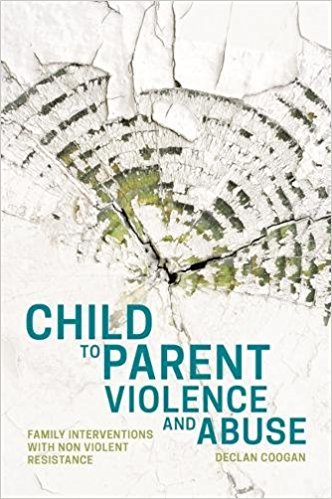
It’s great to see a new book in the field of child to parent violence and abuse coming out later this year from Declan Coogan, who has driven the development of understanding and use of Non Violent Resistance in Ireland.
The book can be pre-ordered on Amazon now, or you can sign up to receive more information from the publisher, JKP, once it is available.
Addressing the under-reported issue of child to parent violence and abuse, this book presents the effective intervention method of Non-Violent Resistance. Tips for adapting the method, alongside case studies and downloadable forms make this an invaluable tool for practitioners working with affected families.
Providing an authoritative overview of the growing phenomena of child to parent violence – a feature in the daily life of increasing numbers of families – this book outlines what we know about it, what is effective in addressing it, and outlines a proven model for intervention.
Based on Non Violent Resistance (NVR), the model is founded on a number of key elements: parental commitment to non-violence, de-escalation skills, increased parental presence, engaging the support network and acts of reconciliation. The book outlines the theory and principles, and provides pragmatic guidance for implementing these elements, accompanied by case studies to bring the theory to life.
Declan was part of the team who worked on the pan-European RCPV project which reported in 2015; and continues to teach, train and develop the work within Ireland.
Family violence and youth justice have been subjected to an intense focus in Australia in the past year. Reviews have revealed the failure to provide effective responses to these issues. Government responses to family violence have emphasised the importance of perpetrator accountability, while in the youth justice field recent reforms have seen a toughening of legal responses.
Adolescent family violence has implications in both of these areas. However, it has been the subject of limited inquiry.
Adolescent family violence is violence used by young people against family members. Most often, it refers to violence occurring within the home.
It is distinct because the adolescent requires ongoing care even when violent, which mean responses used in other cases of family violence can’t readily be applied. It has detrimental effects on the health and wellbeing of families, and is surrounded by stigma and shame.
Extent and impact
Data from the Melbourne Children’s Court show that between July 2011 and June 2016, there were 6,228 applications made for a family violence intervention order where the respondent was 17 years or younger. There were 4,379 cases involving a male adolescent, and 1,849 cases involving a female adolescent.
In 45 cases, the respondent was aged ten-to-11-years-old. In more than half the cases, the affected family member was the female parent of the adolescent.
Existing international and Australian research suggests that adolescent family violence is largely unreported. Consequently, rates of recorded adolescent family violence are likely to underestimate its extent. There are complex reasons for reluctance to report. They include parental shame and self-blame, fear of consequences for the adolescent, and an inability to locate an appropriate service.
Our research into adolescent family violence, which includes an anonymous open survey of those affected, reveals a wide range of abusive behaviours. These extend well beyond physical violence and include coercive and controlling behaviours, property damage, and economic abuse.
One participant described:
Having doors broken in my home either through continuous banging, punching or throwing bricks through the glass. Having a teenager scream and yell at me, swear and belittle me. Being spat on. Having a teenager stand over me and using threatening behaviour to get what he wanted such as money or other items of value.
The effects are severe. People described “walking on eggshells” in their own homes, experiences of depression and stress, and social isolation:
I don’t invite people into my home because of the damage and because my home environment is very unpredictable. I have lost a lot of confidence in my abilities and feel like a failure as a parent. I don’t get much sleep as I am constantly worried for my son’s wellbeing.
Recognising vulnerability and complex needs
Adolescents who use violence in the home often have complex needs and may have experienced family violence themselves. Parents described their adolescents as suffering from substance abuse problems, depression and anxiety, and mental health and intellectual disability disorders.
As one parent described:
My 13-year-old son had major depression and anxiety combined with poly substance abuse. Whenever we tried to challenge him even slightly about his drug use or general behaviour, he would get extremely angry – acting in a threatening manner by standing over us and yelling, hurling abuse and saying horrible derogatory things about us, punching holes in walls, slamming doors until they broke.
All of this was very traumatic and sometimes quite terrifying.
Another recognised her son’s needs, but struggled with the impacts:
My son is 13. He has Asperger’s Syndrome and experiences overwhelming sensory overload with his body flooded with adrenalin. He deals with this by fight or flight, the default being fight. Mostly this involves lashing out with his fists, but he has attempted to use weapons, such as a knife. This only happens when he is overloaded but is frightening nonetheless.
The criminal justice system is not the answer
Recognition of the complex needs of adolescents who use violence in the home suggests that, while family violence committed in any context must not be excused, there is a need to respond to this particular form of it – where possible – outside of the criminal justice system.
Our research is revealing that families who have experienced adolescent family violence and those working with them feel the criminal justice system is not appropriate.
In contrast to cases of intimate partner violence, where separation of the parties involved and obtaining an intervention order or court outcome may be a priority to ensure safety, parents often want to maintain the family unit in adolescent family violence cases, and are acutely aware of the stigma and consequences of criminalising their child’s behaviour.
Survey respondents describe the reasons why they had chosen not to contact police. One mother commented:
We were worried that if we called the police things would escalate more … We also thought that if we called the police we would completely lose any remaining trust or relationship with our son.
The small number of survey respondents who did contact police felt such interactions were unhelpful. One mother said:
On each occasion, I have felt that the situation was futile. Through calling the police [our son] felt like I have betrayed him … it did not result in an outcome where our family got any support or help.
The need to move away from criminal justice responses is important to emphasise in the current political climate, where youths are increasingly facing more punitive consequences for using violence.
Recognition of the complex needs of all those impacted – including adolescents who use violence, and their parents, carers and siblings who are victimised – reinforces the need to look beyond punitive justice responses in tackling this form of family violence.
New knowledge and new specialist responses
Victoria’s Royal Commission into Family Violence found that there is a limited understanding of adolescent family violence among family violence specialists, youth and family services, and in the justice system.
Our research aims to contribute to urgently needed knowledge about adolescent family violence’s nature, extent and impacts. Across Australia there is a need to better understand this complex form of family violence, and to develop specialist knowledge and multi-agency responses.
Effective responses will require government commitment in terms of specialist funding and the resourcing of new forms of integrated service responses.
If you have experienced adolescent family violence, please consider sharing your experience with us via our anonymous online survey.
The National Sexual Assault, Family & Domestic Violence Counselling Line – 1800 RESPECT (1800 737 732) – is available 24 hours a day, seven days a week for any Australian who has experienced, or is at risk of, family and domestic violence and/or sexual assault.
I spent last Friday at the NVR UK 2017 conference in London, where it was great to catch up with colleagues and people I had previously only known through twitter, to make new friends, and to learn how the practice of Non Violent Resistance (NVR) can be applied to all areas of life.
There were two keynote speeches, followed by a series of workshops; and one I was particularly interested in was about the establishment of parent groups connected with de Wiekslag, an organisation in Belgium working with high risk young people and their families. These groups are for parents of young people exhibiting very serious challenging behaviour (including violence to parents), or engaging in school refusal, self harm or running away, and they are described as “slow open groups”, with no course beginning or end, and parents can attend for as long as they like, or need – typically 9 to 12 months. When they leave, a place becomes available for another family. Continue reading →





 HOLES IN THE WALL