Tag Archives: Parent abuse

Sophie Cero PhD- Holes in the Wall update.

We last heard from Sophie Cero in October 2018 (https://holesinthewall.co.uk/2018/10/31/an-eye-for-detail-an-interview-with-sophie-cero/) when she was starting her Fine Art PhD, taking a unique approach to investigating the violence from a child to their parent. Now that this is completed, Sophie has written us an update and included some art work from the research. While other people have used art work as part of the therapeutic process, as a diary record, or as a method of illustrating research, this was the first time that the whole project has been undertaken from a visual point of view. 

You might find it helpful to reread the earlier blog first to remind yourself about her work.

Sophie is the first in our ‘mothering’ series, and we are happy to welcome her back to HITW

Explored through my artistic practice, in writing, film and objects, my Royal College of Art, PhD research project ‘Little Horror. At home with filial violence’, sought to make visible the maternal experience of CAPVA, which, as perhaps the last taboo, is one of the few instances where it is almost impossible for a mother to own and tell her own life story. Revealing it challenges the very nature of motherhood and places the mother in the role of both victim to and creator of the problem. Someone who she may love and fear simultaneously, and who above all, she wants nurture and to keep safe. To turn away from nurture and to reject the child for reasons of safety is almost impossible, every turn has a devastating consequence, every aspect of life into trauma in waiting, making the mother trapped in an impossible life with an impossible child. This mother must both protect and survive her child.

In the seven years of study, the most compelling finding I have encountered is how commonplace the experience is. When describing my research, I found it astounding how many people had had an encounter with it in some form, be it from a sibling, a neighbour or their own child. On the opposite side to this, I had several instances of open disbelief, of misunderstanding, of incredulity, with the listener being convinced that surely, I had mis-spoken, I must have meant the mother being abusive to her child. 

Working through art practice as opposed to more traditional research strategies, allowed me to develop my own methodology and to form an inquiry that would be hard, if not impossible to replicate through usual research gathering approaches. It allowed me to think around the spaces of events within the home, and to find common themes that occur within objects and places, and commonalities across different ages of mother and child. 

Finding no existing direct artistic representations, my research sought out contemporary parallels that held elements of the experience within them, in art, film and literature, taking a wide frame of reference from disparate sources ranging from Lacan to Family Guy. This study was initially underpinned by the idea of CAPVA being akin to ‘the maternal unheimlich’, considering Freud’s writing on The Uncanny, when viewed through a maternal frame. This led to the realisation that CAPVA bears resemblance to the horror film genre, relating to key elements such as ‘the scary place’, ‘the final girl’ and ‘the ominous atmosphere’. This applied to all horror tropes except for that which makes horror exciting, enticing and unpredictable, ‘the jumpscare’. Here the scares are expected and known.

I worked with existing testimonies from mothers that highlighted domestic objects as being integral to violence within the walls of the home, the objects acting as if witnesses to events. This methodology allowed for difficult stories to be retold and represented through a universalised, fictional birth mother and her (ungendered) child, Mymmy and Vic, as holders of trauma events.

I used a process of writing and diagrammatic drawing to analyse and represent the episodes of abuse, with the final outcome being to assimilate the ‘object events’ into a film script, which documents a day/18 year period of the relationship between Mymmy and Vic. It is my intention to further the research and to find funding to realise the film script in the near future.

Since embarking on the project in 2017, when research was sparse and awareness very limited, it is heartening to see that interest in the subject has increased and I hope this will continue.

Suggested Image(s)

Sophie Cero. Safeguarding wallpaper (Christmas edition) 2024

Sophie Cero. Object Event (crockery) 2021 – diagrammatic timeline drawing

Sadly it is not possible to read the final paper as it has been embargoed to protect those involved, but Sophie is on Instagram as sophie_cero and you can view more of her work there.

Leave a comment

Filed under Announcements, Family life

International Child To Parent Abuse Conference

On October 14th, 2024, Parental Education Growth Support (PEGS) hosted an International Child to Parent Abuse (CPA*) conference online.  The conference was well attended, provided British Sign Language Interpreters for every presentation, and there were a range of speakers from around the globe with the goal of fostering “a collaborative environment where stakeholders can share knowledge and strategies to better support those impacted by CPA” (PEGSupport.co.uk).

A clear thread which ran through the day was the way in which different professionals, practitioners, and researchers were using a public health approach to understand CPA. 

The first speaker, His Honor Judge James Burbidge, highlighted that substance misuse is often found in cases that are seen in the Crown Court, providing two case examples of adult children, one was initially charged with attempted murder of her mother, the second was an adult child who had sexually assaulted his mother and planned to physically harm her. Julie Mackay provided case examples of patricide in her afternoon presentation. Substance misuse and serious mental health issues of the adult children were considered a prominent feature in every presentation. Amanda Warburton Wynn’s case study of a grandson who murdered his grandmother also referred to significant mental health issues and the pressures of mutual caring responsibilities. The lack of support for those supporting children or grandchildren with mental health challenges is a clear issue which has led to terrible outcomes for whole families.

More positively, PEGS have been working with Brightstar for many years, and they provide sessions for young people at risk of causing harm through a needs-based understanding (i.e. if a person has their needs met, they are less likely to cause harm). With a Believe, Belong, Become throughline, Brightstar begin each session with boxing, helping young people to meet their affective needs and regulate their emotions, they then continue to a behavioural session talking through thoughts and feelings (affective needs, relational needs). The importance of recognising unmet needs was also outlined by Jeremy Todd (Family Lives) through a violence-reduction programme of work in which parents are supported to understand and not normalise of minimise the harm, which includes supporting children with their neurodivergent, mental or emotional health needs.

Other, specific, CPA intervention programmes were outlined by Dr Andy Newman. A particular challenge in ‘what works’ for CPA is the lack of consistency, lack of long term data, and whilst many of the interventions mentioned have shown promising outcomes, it is clear that there is no one-size fits all, with some interventions being applied on populations they were not designed for (i.e. positive behavioural support for autistic children when it was designed for children with learning disability). What is clear is that there are many excellent services available, so much so that responses may be positive because of the good working practices, rather than the usefulness of a particular intervention.

NHS Safeguarding reported similar challenges, particularly regarding the relevance of neurodivergence and poor mental health in this area; that diagnoses are not labels, but a useful lens in which to understand a child’s experiences in the world. This concurred with Amanda Holt’s findings, who also found that parents would focus on the wellbeing of their child over their own safety. Both presenters, as well as Dr Silke Meyer in the afternoon session highlighted that a whole family approach, one which recognises that they have individual needs, as well as family needs, is important. Furthermore, recognise the wider family or systems, as many children live outside the family or with others in a parenting role.

A more systematic approach to tackling CPA was identified by Sarah Townsend who shared findings from her Winston Churchill Memorial Trust Travel Fellowship, exploring how New Zealand could learn from the UK and Australia when implementing policy guidance. How policy can stay ahead of progress is a challenge through, as highlighted by Emma Pickering, tech-facilitated abuse is evolving faster than policy-makers can keep up, and this has resulted in harmful artificial-intelligence generated imagery. Furthermore, just parents increasingly monitor their children’s locations using technology, children are doing the same for their parents.

How to help families through the lens of public health was clear throughout, with an emphasis on looking at how certain features of a person’s identity creating additional barriers to accessing support. Kate Fejfer spoke to how those from Eastern Europe have specific challenges when accessing support for domestic abuse more broadly, whereas Polly Harrar (CEO The Sharan Project) talked through the challenges South Asian families, and particular mothers, have when navigating CPA. Vulnerabilities of older adults was discussed by Rebecca Zirk, with Richard Robinson (Hourglass service) advocating for an older person’s commissioner, as Northern Ireland and Wales have one, but England and Scotland do not. 

PEGS is continuing to engage in a myriad of awareness raising activities of CPA, led by their founder Michelle John. Comments relating to the conference can be found on social media via #StandWithPEGS, and employers are encouraged to sign their CPA covenant to support any employees living with CPA.

Find out more about the event, and future PEGS events:  https://www.pegsevents.co.uk/

Nikki Rutter

*CPA is the preferred terminology of PEGS and the parents involved with them, and so is the language used throughout this blog.

Leave a comment

Filed under conference report

Adolescent to parent violence – hearing from the young people themselves.

Exploring adolescent violence and abuse towards parents: the experiences and perceptions of young people, Victoria Baker. A thesis submitted in partial fulfilment of the requirements for the degree of Doctor of Philosophy at the University of Central Lancashire, August 2021.

Much work exploring child and adolescent to parent abuse comments on the difficulties inherent in hearing from the young people themselves, skewing the literature towards an interpretation of the phenomenon through a particular lens. Sometimes parents feel uncomfortable putting their children forward, sometimes agencies express concern that it would be inappropriate or potentially damaging, sometimes ethical factors around risk preclude the involvement of these voices in research. As a result, there is a focus on the point of view of parents and practitioners, and an important aspect of understanding and analysis has been absent up to now.

Continue reading

Leave a comment

Filed under Research

A response to the proposed changes to Domestic Abuse legislation in Britain

These comments are my own and do not necessarily represent those of other parties working and interested in the field of child to parent violence.

I have used the terms adolescent to parent abuse (APA), adolescent to parent violence (APV), child to parent violence (CPV), and parent abuse (PA) interchangeably, except where this has been made clear, to reflect the different usage at different times and by different people.


This week the Government published their landmark Domestic Abuse Bill, alongside the response to the Consultation, Transforming the Response to Domestic Abuse. The Consultation looked at four specific areas:

  • promoting awareness
  • protecting and supporting victims
  • transforming the justice process and perpetrator response
  • and improving performance.

The Consultation Response and the Bill have been welcomed by many, particularly for the inclusion of economic abuse within the definition, recognition of the harm afforded to children and young people affected by domestic abuse (DA) within the family, for the protection afforded to victims and witnesses in court, and for the commitments to secure tenancies for those being rehoused. Nevertheless, there has been significant concern expressed about the need to translate words into actions, with adequate funding of services. Particular interest groups have rightly pointed out areas where they feel commitments could have been stronger, or where a change of direction is needed. Continue reading

9 Comments

Filed under Discussion, Law

Collaboration across agencies is key in work with families experiencing child to parent violence

Great to see a blog from Dr Simon Retford, Detective Superintendent at Greater Manchester Police, on the  N8 Policing Research Partnership website (September 13th). Simon spoke at the recent N8 Knowledge Exchange Conference in Darlington, and he reflects here on the content of his presentation.

Police Collaboration Opportunities and Child to Parent Violence 

In June 2018 the N8PRP held its annual Knowledge Exchange conference. The theme for this year was child-to-parent violence (CPV), its complexities, recognition as an issue and prevention. 

In this blog-post Dr Simon Retford, Detective Superintendent at Greater Manchester Police, gives us an insight into CPV through research undertaken to complete his Professional Doctorate and extensive policing experience. 

Within the confines of family violence, domestic abuse has become a widely recognised problem across all sections of society. As a greater understanding of the complexities of such abuse has evolved, so has the responding and support opportunities grown, to better support those involved (Hester, Pearson & Harwin, 2009, pp.110-111). However, one particular area which has avoided extensive academic research, is abuse perpetrated by children against their parents (Jackson, 2003, p.321,). Gaps between parent abuse and domestic abuse research have been reported, particularly where responses to it are concerned, with a suggested ‘policy silence’ for parent abuse (Holt and Retford, 2013, p.2).

You can read the whole blog here.

Leave a comment

Filed under conference report, Discussion, Research

Summer #CPV harvest

I am often asked how I come across the news, articles and publications that I tweet and blog about, in relation to child to parent violence (CPV). My original rationale for this site was along the lines of  “I do it so you don’t have to”, but of course things are never that straight forward, and the truth is much more like “we do this together”. But here goes: Continue reading

2 Comments

Filed under Discussion

Child to parent violence: an unhelpful phrase?

Once upon a time, when I didn’t know so much about “parent abuse” it seemed a little exciting to be at the forefront of a new phenomenon. It felt important to speak clearly and categorically, for clarity, and the avoidance of misunderstanding – which was commonplace. “Parent abuse? You mean abuse BY parents? No? You must mean older people then?” Now it seems that the more I learn, the less certain I am about anything – other than the fact that many, many more parents than we would like to think about are struggling daily with much, much more than anyone should ever have to face within their family. Continue reading

2 Comments

Filed under Discussion

Happy Birthday, Holes in the Wall!

Please allow me a moment of self-indulgence as I celebrate 5 years of this website, Holes in the Wall, ‘born’ in May 2011 out of a desire to make a contribution to the understanding of children’s violence to parents, known sometimes as parent abuse. As a present to myself I have ordered shiny new postcards to leave with people at conferences and events, explaining how ‘Holes’ came about and how you can be part of the community!

IMG_3945

Continue reading

1 Comment

Filed under Discussion

Alice Flowers advocates for parent abuse bill in Florida.

Family Of Woman Who Lost Her Life Plead With Lawmakers To Hear Parent Abuse Bill


Some Florida lawmakers and advocates are pushing for a bill classifying the abuse of a parent as a form of domestic abuse. The measure stems from a woman who lost her life years ago.

Flowers is recalling the painful memory of the events that led to her sister, Rosemary Pate’s death. Pate’s son Everett was sentenced to 30 years in prison for the murder.

“She had suffered years of abuse from him,” she added. “Although he had been detained in the Department of Juvenile Justice, many times he was returned home to her where the abuse continued, although law enforcement were aware of the threats.”

And, Flowers says losing her sister like this has been tough on the whole family.

“My father has been through a lot,” she continued. “He got a call. Early one morning, my youngest sister and her husband went to his house to let him know that his grandchild had murdered his child. We have been through the ringer with this.”

Flowers just finished a bicycle ride from Orlando to Tallahassee in memory of her sister. Now, she’s advocating on behalf of a bill that she says would have helped.

“Myself and four cyclists have cycled to show how serious we are about getting a bill for police protections for parents and a bill that would begin intervening early for troubled children,” she concluded.

That bill Flowers is pushing for is sponsored by Sen. Geraldine Thompson (D-Orlando).

“We know that in Orange County we have a problem because we’ve studied it,” she said. “And, 426 children were arrested in 2012 for domestic violence, physically assaulting family members in their own homes. And, according to an article, elderly people are likely to be hurt by their children or other caretakers more than any other individual.”

And, Thompson says she’s saddened that even with a restraining order stating that Pate’s son had threatened her and she’d been afraid of him for years, the 51-year-old’s petition went nowhere.

“He had indicated that he would kill her two years earlier when he was 16,” Thompson added. “She said her petition to the judge had not really been acted upon because right now, in the law, regarding domestic abuse, the abuse of a parent is not included and so, this bill would correct that. And, it would include abuse of a parent as one of the forms of domestic abuse.”

The abuse may include aggravated abuse, exploitation of a parent’s assets, or emotional abuse of a parent by a biological child. The bill also requires the abuse of a parent be reported to the state abuse hotline.

And, Rep. Victor Torres (D-Orlando), the bill’s House sponsor, says the measure is needed.

“We need to make sure our parents are protected against abusive children,” he said. “The abuse tends to begin with verbal abuse, gradually progresses to property damage, breaking the walls, breaking down doors…ultimately, it becomes physical and that’s when you have the problems, that’s when you start seeing the aggression against the parents.”

So far, neither the Senate nor the House bill have had a hearing. But, both sponsors say they remain hopeful that if it dies this year, it will still be heard next session.

Continue reading

2 Comments

Filed under news reports

Lazy reporting could not spoil an opportunity to discuss parent abuse

This started off as a weary rant from me today and then changed tone as the day progressed!

While it has been exciting and encouraging to see the increase in coverage of child to parent violence and abuse in the media over the last week, I have been disappointed yet again by the tone of some of the pieces and the apparent laziness of reporting.

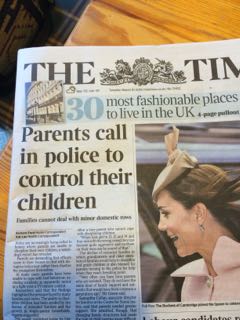
Times headline

The main headline in the Times, (you may not be able to read the next line, “Families cannot deal with minor domestic rows”)  today picks up on the report from Her Majesty’s Inspectorate of Constabulary into the welfare of vulnerable people in police custody, which has held centre stage across the media today. This highlights the often inappropriate use of custody for individuals experiencing poor mental health, or other vulnerabilities, because of a crisis in other support services; and while researchers have said that the findings show pressures faced by many families and carers, and the fact that the police are often used as the agency of last resort, the first example given – thus setting the tone – is of a dispute over a TV remote control. Other examples are given of greater severity of risk and violence. Parents are described as contacting the police because they reach breaking point. But there is no exploration of this issue in a wider way, other than to suggest lone women are finding it particularly difficult to bring up children. Continue reading

2 Comments

Filed under Discussion, news reports, radio and video