In June 2006 an article in the Times newspaper reported on a parliamentary Health Committee inquiry, set up in 2003 and prompted by estimates that up to 50,000 of Britain’s elderly were subject to abuse from relatives and carers. The inquiry declared the abuse of the elderly to be Britain’s “last hidden abuse scandal.” This weekend the Observer has reported on former health minister, Paul Burstow’s concern that figures show as many as 370,000 older people were abused in their home last year – a “hidden national scandal” – and that the number is likely to increase to nearly half a million by the end of the decade. These figures are based on data extrapolated from a survey of 2000 people in 2007. Nevertheless, they suggest that this is a story that has captured the imagination of those in power. Continue reading
Tag Archives: Child to parent violence
You can’t afford to dabble
Can anyone respond to a referral of parent abuse? Since we are encouraging practitioners to recognise when child to parent violence is a feature of family function or dysfunction, what are people supposed to do next? How should they intervene? Do you need to follow an approved programme, or can you use practice that works in other settings?
A discussion with Sandra Ashley, Director of Hertfordshire Practical Parenting Programme, touched on these questions as we looked at the range of support programmes on offer and the training offered to facilitators. (You can learn more about some of these programmes on the Resources pages of this blog) Some of these programmes have commonalities. Others feel quite different in emphasis and style and in philosophical background. Meanwhile, bespoke parent abuse projects increasingly find that they are taking referrals from mainstream agencies that feel their own staff lack the necessary expertise (or time perhaps?), while initiatives such as that falling within the Troubled Families remit may be using practitioners from a range of backgrounds to tackle this among many other issues. Continue reading
Filed under Discussion
Model students perpetrating abuse
If, like me, you prefer your maths concrete and you use things like a classroom of students as a unit of measurement, then you might find this image interesting. Courtesy of Ipswich Borough Council White Ribbon Day, it represents the number of students in a class likely to be perpetrating violence at home – those wearing ties. We can argue over the exact number, depending on the level of violence we are counting – and we might never know the true figure – but images like this can help to make something a bit more real and less of something happening out there to other people.

Photograph © Lorraine Arthur Continue reading
Filed under Discussion
No rules about controlling relationships
Coverage of an assault by Charles Saatchi on his wife Nigella Lawson, outside a London restaurant at the weekend, has sparked considerable debate in the press and on social media – not least as to why people felt it was OK to photograph and document events, rather than intervene.
Writing in the Telegraph, Iris McCann and Dr. Petra Boynton have used the opportunity to discuss the different faces of domestic abuse, and to offer advice to those who recognise their experience. Continue reading
Filed under Discussion, news reports
Adolescent to parent abuse: the facts
I was interested to be sent this fact sheet recently, by Heather Nancarrow, Director of the Queensland Centre for Domestic and Family Violence Research, CQ University. The leaflet was produced to support parents who might be experiencing abuse from their children, with clear outlines of what counts as abusive behaviour, recognising how parents may be feelings and reminding them of their right to live free of abuse and violence. It is distributed (among other places) to police stations, one of the key places parents may first seek help. The addresses and contact details are of course only relevant to Australia, but the information given is useful to all; and the layout and presentation very attention grabbing.
It was one such leaflet that prompted this article in the Gladstone Observer, on May 31st.
The reporter took the opportunity to interview a police officer and a youth worker involved in supporting parents, as well as Nancarrow. Parents are urged to start disciplining their children early, recognise the signs of parent abuse, and to come forward for help if necessary. The article is a little confused in its structure, but its good to see the issue of child to parent violence receiving attention and recognition in the media again.
Filed under news reports
Non-Violent Resistance: the story so far
Of the different techniques and programmes in place to work with parents experiencing abuse from their children, the one we seem to hear least about (at least in the UK) is Non-Violent Resistance. As part of the EU-funded research into effective methods of work with families, Paula Wilcox of the University of Brighton has been examining evidence for this programme. Non-Violent Resistance was first developed in Israel and later adapted by a team led by Declan Coogan in Ireland. In this piece, written specifically for Holes in the Wall, Declan Coogan gives a brief introduction to its methods, use and effectiveness. Continue reading
Filed under Discussion, Training opportunities
Speaking to the media
This is a bit of a different post to usual. I’ve alluded to the interest of the media in parent abuse in recent weeks, but as this has come up over and over again recently I thought it worth a mention in its own right. In a nutshell, the question seems to be, how do we reconcile our desire to raise awareness of parent abuse and the need for greater service provision, with our duty to protect the families we work with from further harm?
Over the years that I’ve been tracking this, child to parent violence, or parent abuse, has been covered in what we’ll call a “positive” way in various media: in the local and national press, in professional publications as well as academic journals, in a popular weekly magazine, on radio news and magazine programmes, in TV drama and documentary, in film and on YouTube; and those are just the ones I’ve caught. It’s also attracted attention in more dramatic and contraversial ways through programmes such as Dr Phil, where families are “paraded” in front of audiences who have chosen to be present for motives which, it’s probably fair to say, don’t include the hope of witnessing a complex, sensitive process of restoring healthy family relationships. Then there’s the other side of the story in the context of the long-term failure of mainstream agencies to respond to families experiencing abuse from their children. How will the professionals come out of this? Do we really want to put ourselves through further grief at a time when the drive is rather to find positive stories of social work involvement to bring balance to the argument? Continue reading
Filed under Discussion
Training session for parents
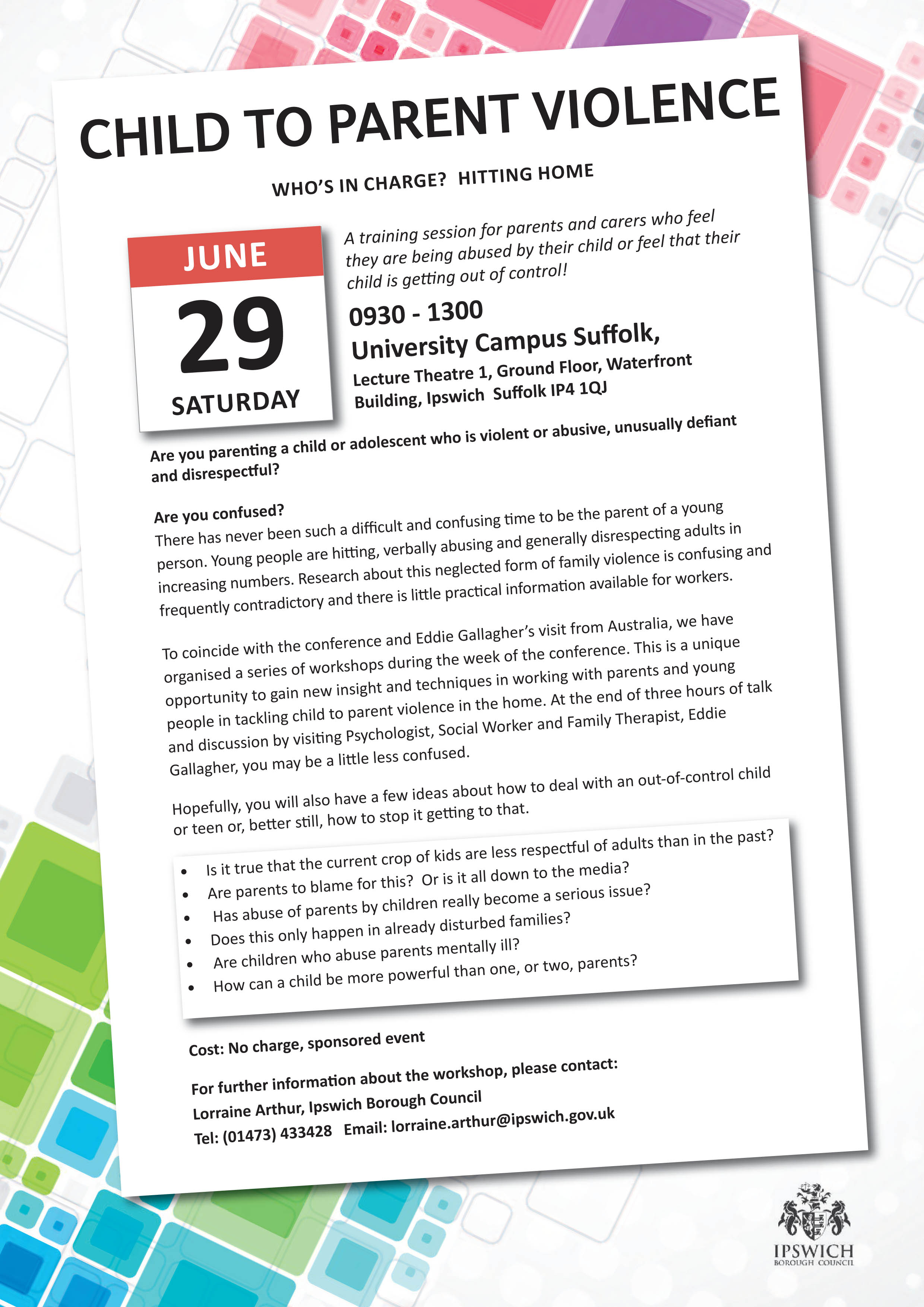
I’m very excited to post this flyer about a training day specially designed for parents and carers experiencing abuse from their children.
This morning session on June 29th, offered at no cost to participants, follows on from 3 days of training for practitioners working with abused parents, organised by Ipswich borough council, and will be led by Eddie Gallagher. (Booking details on the flyer.)
It’s not often that parents and carers are offered this chance and so I hope that it will reach as wide an audience as possible.
Filed under Training opportunities
A successful year for Hertfordshire Practical Parenting Programme
A year ago I spotted a piece in the Hertfordshire local press about a big lottery grant awarded to a new project working with families experiencing child to parent violence. Last week Hertfordshire Practical Parenting Programme celebrated a successful year, and invited me to join them for a reception.

Sandra Ashley, Director (second left), Carole Hassell (right), Geoff Ogden from the Management Team and Carol Lewis (left ), pictured above, were joined by local councilors, Chris Mitchell, Paul Seeby, John Barfoot , the Broxbourne MP Charles Walker. Dunston Patterson from the Youth Justice Board, and representatives from the local Parks Department and police were also present. Continue reading
Filed under projects

 HOLES IN THE WALL