It was great to see us included in this piece in the Guardian by Moya Crockett: ‘My child would use anything as a weapon’: the parents who live in fear of their offspring | Parents and parenting | The Guardian
The Guardian Highlights the Reality of CAPVA—And Why It Needs More Attention
Filed under news reports, publications
Norfolk PCC : Pilot to help vulnerable young people will provide a lasting legacy
A pilot to provide specialist support to families affected by child to parent abuse has been celebrating its positive outcomes.
The pilot has already offered support to 81 children and young people and their families.
Over 70 practitioners across Norfolk Children’s Services, Norfolk Youth Justice, NIDAS and some Norfolk schools have been trained to deliver Respect’s accredited intervention ‘The Respect Young Peoples Programme’ also known as the RYPP. The intervention is for families where children or young people aged 8-18 are displaying repeated abusive and harmful behaviour towards their parent or caregivers (including stepparents, adoptive parents, foster carers and kinship carers). This abuse can be physical, verbal, emotional, psychological, sexual, financial, damage to property, coercive and controlling.
Norfolk’s Police and Crime Commissioner, Sarah Taylor, said: “Thanks to funding from the Home Office’s Perpetrator Fund, this pilot has given us a rare opportunity to work closely with families experiencing child- and adolescent-to-parent violence and abuse. Some families experiencing this type of violence or abuse have said that they feel stuck between a rock and a hard place as they don’t necessarily know how to best cope with the situation but don’t want to get the police involved. By working with other organisations including NCC’s Children’s Services, Youth Justice and NIDAS, this project has worked with families to help transform the support available, which in turn has helped them navigate these difficulties.
“Early findings show this work had had a profoundly positive effect on families involved, with a reduction in the need to involve the police or other services in interventions.”
“This joined up approach represents true partnership working. The Child and Adolescent to Parent Violence and Abuse (CAPVA) project has been overseen by my office and delivered in partnership with Respect, Norfolk Constabulary, Norfolk Integrated Domestic Abuse Service (NIDAS), Youth Justice, Norfolk Children’s Services and Brave Futures.
“As part of the project, NIDAS recruited two full time CAPVA advocates, a UK first, and Brave Futures provided therapeutic support for young people who require extra support prior to engaging in the RYPP. I am delighted that this project has trained 72 practitioners to deliver the RYPP directly to families and the work by these practitioners will provide a lasting legacy.”
Justine Dodds, Head of Respect Young People’s Service, said: “The Respect Young People’s Service (RYPS) has been delighted to work with the Norfolk Police and Crime Commissioner this year and last. The programme has two dedicated Children and Adolescent to Parent Violence and Abuse (CAPVA) workers whose only role is to work with families on this specific type of abuse.
“This is the first time the Respect Young Peoples Service has trained staff in schools. This has been very exciting, with the potential to reach families before they hit crisis point and are forced to contact statutory services.
“The awareness raising work that we have delivered across children’s services and police is helping to improve understanding and empathy, and to identify what is often a ‘hidden harm’.
“We want to champion our partners and the people that we have trained so far. This programme has the potential to be truly transformational and preventative by stopping CAPVA, before it starts.”
The Respect Young People’s Programme – how does it work?
The Respect Young People’s Programme (RYPP) is voluntary, and both the young person and their parent/guardian must consent to take part and be willing to engage. The programme avoids blame and works together with both the parents/carers and young person, seeing them all as part of the solution. The programme is designed to enable families to identify negative behaviour patterns and work towards positive outcomes.
RYPP practitioners provide support, insight, and simple solutions to help to improve family relationships via weekly structured sessions and takes approximately three or more months to complete. Sessions are varied and use a variety of creative tools and techniques, underpinned by theoretical models – primarily social learning theory, cognitive behavioural approaches, restorative justice, and conflict resolution.
One RYPP practitioner supporting their client said:
“The family engaged well throughout and really took on board everything within the sessions. I feel very proud of how far they’ve come and the improvement in their relationship and conflict resolution.
“The positive change in behaviour and reduction in aggressive, violent and or abusive behaviour has been wonderful to witness and reinforces my belief in the programme.”
Therapeutic support for children and young people
As part of the CAPVA Project, therapeutic support is provided to children and young people via a new service known as Changing Futures. Delivered by Brave Futures, a spokesperson explained the benefits: “Changing Futures provides a safe environment where children and young people can explore their emotions, gain deeper insight into their behaviours, and minimise their impact on others. Our support encourages self-regulation and equips them with healthy coping strategies to better manage their future. We are already witnessing the positive effects of this therapeutic approach, as children and young people are building trust, applying strategies learned in sessions, and showing improved engagement with education and employment.”
Families have their say
One young person after taking part in the Respect Young People’s Programme said: “It’s 100% helped me and mum and we have conversations every day. It’s not just helped me but it’s helped my whole family. We’re much happier now.”
Parents have fed back on how the programme has improved family life. One parent said: “It has been really helpful. My child has taken some tips from it and has been taking some things in and has been thinking a little bit before they act.”
Another parent said: “It is the first time in four years I have felt we have a worker who understands the issues, listens and affirms, and is able to come up with effective and positive interventions and it has been a completely invaluable experience which we will continue to benefit from. We’ve loved working with our RYPP worker.
Early findings from the pilot have shown that all RYPP practitioners have reported a reduction in violence and abuse for the families that have completed the programme.
*After completing the programme, 93% of parent/carers surveyed said it had helped to improve their relationship with their child. A resounding 100% of their children said that it had helped to improve their relationship with their parent/caregiver.
For more information about The CAPVA project
In March 2024, partners, practitioners, and academic experts came together to discuss best practice and to share academic research at The Nest in Norwich. The day’s conference provided an opportunity for services across Norfolk to raise awareness of CAPVA, to network and to shine a light on the great work already achieved.
*Data collated as of 8 November 2024.
Filed under projects
International Child To Parent Abuse Conference
On October 14th, 2024, Parental Education Growth Support (PEGS) hosted an International Child to Parent Abuse (CPA*) conference online. The conference was well attended, provided British Sign Language Interpreters for every presentation, and there were a range of speakers from around the globe with the goal of fostering “a collaborative environment where stakeholders can share knowledge and strategies to better support those impacted by CPA” (PEGSupport.co.uk).
A clear thread which ran through the day was the way in which different professionals, practitioners, and researchers were using a public health approach to understand CPA.
The first speaker, His Honor Judge James Burbidge, highlighted that substance misuse is often found in cases that are seen in the Crown Court, providing two case examples of adult children, one was initially charged with attempted murder of her mother, the second was an adult child who had sexually assaulted his mother and planned to physically harm her. Julie Mackay provided case examples of patricide in her afternoon presentation. Substance misuse and serious mental health issues of the adult children were considered a prominent feature in every presentation. Amanda Warburton Wynn’s case study of a grandson who murdered his grandmother also referred to significant mental health issues and the pressures of mutual caring responsibilities. The lack of support for those supporting children or grandchildren with mental health challenges is a clear issue which has led to terrible outcomes for whole families.
More positively, PEGS have been working with Brightstar for many years, and they provide sessions for young people at risk of causing harm through a needs-based understanding (i.e. if a person has their needs met, they are less likely to cause harm). With a Believe, Belong, Become throughline, Brightstar begin each session with boxing, helping young people to meet their affective needs and regulate their emotions, they then continue to a behavioural session talking through thoughts and feelings (affective needs, relational needs). The importance of recognising unmet needs was also outlined by Jeremy Todd (Family Lives) through a violence-reduction programme of work in which parents are supported to understand and not normalise of minimise the harm, which includes supporting children with their neurodivergent, mental or emotional health needs.
Other, specific, CPA intervention programmes were outlined by Dr Andy Newman. A particular challenge in ‘what works’ for CPA is the lack of consistency, lack of long term data, and whilst many of the interventions mentioned have shown promising outcomes, it is clear that there is no one-size fits all, with some interventions being applied on populations they were not designed for (i.e. positive behavioural support for autistic children when it was designed for children with learning disability). What is clear is that there are many excellent services available, so much so that responses may be positive because of the good working practices, rather than the usefulness of a particular intervention.
NHS Safeguarding reported similar challenges, particularly regarding the relevance of neurodivergence and poor mental health in this area; that diagnoses are not labels, but a useful lens in which to understand a child’s experiences in the world. This concurred with Amanda Holt’s findings, who also found that parents would focus on the wellbeing of their child over their own safety. Both presenters, as well as Dr Silke Meyer in the afternoon session highlighted that a whole family approach, one which recognises that they have individual needs, as well as family needs, is important. Furthermore, recognise the wider family or systems, as many children live outside the family or with others in a parenting role.
A more systematic approach to tackling CPA was identified by Sarah Townsend who shared findings from her Winston Churchill Memorial Trust Travel Fellowship, exploring how New Zealand could learn from the UK and Australia when implementing policy guidance. How policy can stay ahead of progress is a challenge through, as highlighted by Emma Pickering, tech-facilitated abuse is evolving faster than policy-makers can keep up, and this has resulted in harmful artificial-intelligence generated imagery. Furthermore, just parents increasingly monitor their children’s locations using technology, children are doing the same for their parents.
How to help families through the lens of public health was clear throughout, with an emphasis on looking at how certain features of a person’s identity creating additional barriers to accessing support. Kate Fejfer spoke to how those from Eastern Europe have specific challenges when accessing support for domestic abuse more broadly, whereas Polly Harrar (CEO The Sharan Project) talked through the challenges South Asian families, and particular mothers, have when navigating CPA. Vulnerabilities of older adults was discussed by Rebecca Zirk, with Richard Robinson (Hourglass service) advocating for an older person’s commissioner, as Northern Ireland and Wales have one, but England and Scotland do not.
PEGS is continuing to engage in a myriad of awareness raising activities of CPA, led by their founder Michelle John. Comments relating to the conference can be found on social media via #StandWithPEGS, and employers are encouraged to sign their CPA covenant to support any employees living with CPA.
Find out more about the event, and future PEGS events: https://www.pegsevents.co.uk/
Nikki Rutter
*CPA is the preferred terminology of PEGS and the parents involved with them, and so is the language used throughout this blog.
Filed under conference report
A Personal Announcement
When I started this website in 2011, I had very grandiose ideas – bringing together everything in the world about CPVA into one place, while simultaneously being incredibly naïve about how I would achieve that – or how long I would carry on for! As it happens, it has proved to be both a challenge and a privilege to keep it going for so long and to learn so much myself along the way.
In June this year I announced my plans to retire, and although I had been winding things down for a while, I was absolutely clear that ‘Holes’ should carry on, and so I have been working with a number of people over the last months to ensure this can happen.
I am delighted now to let you know that from November 2024 this website will be managed by a team of people with vast experience in this area of need and work, in terms of research, practice, training and personal experience; a team made up of Capa First Response and Durham University. I hope and believe that, under their leadership and management, ‘Holes’ will carry on – and indeed develop in the future – to reach an even bigger audience, and provide a more comprehensive and helpful service for all those who access it. I am pleased to leave it in good hands, and look forward to seeing how it develops over the next 10 years!
In the meantime, thank you all for all your support and encouragement; for the contributions that many have made in terms of advice, content and comments, and indeed for all the work that you all do. I hope you will continue to supply all of those for the new team going forward, and that you will join me in wishing them all well.
Very best wishes, Helen
Filed under Announcements
CPV: The podcast special
How do you consume your podcasts?
On the way to work on the train? Walking the dog? While you’re doing the ironing? Or do you find a quiet half hour to focus solely on the content? However you find the time, there are some great podcasts out the at the moment, focussing either specifically on children using harmful behaviour towards parents – CPV – or on different approaches to working with families to bring about a more healthy and hopeful life. These may be directed first and foremost towards professionals – offering guidance for work with families, or they may offer tips and strategies directly to those affected. Whatever you are looking for, they all remind us that this is something that is more prevalent than we might have imagined previously, but that there is hope when you find the right people who know their stuff!
By no means a definitive list, but here is a selection of some of the top podcasts regarding CPV.
The Adoption and Fostering podcast is now in its 9th year, with nearly 200 episodes in the library. Al Coates and Scott Casson-Rennie discuss a range of issues related to contemporary adoption and fostering, often with special guests. Many of the episodes touch on children’s aggressive behaviour towards parents and carers. A fair number focus on this issue specifically. While this is labelled as adoption and fostering, many in other fields will find topics of relevance.
Capa First Response launched Series 1 of their podcasts in early 2024 and already have a second series ready to go. Series 1 features conversations between founder Jane Griffiths, Senior Practitioner Matt Rider, and patron Helen Bonnick, and touched on more general issues regarding child to parent violence and abuse which come up frequently in discussion, while the next episodes will address more specific topics such as neurodiversity. There is a third series in the planning stage.
The NVR podcast is aimed both at professionals and families, with experts in the field discussing strategies, the rationale behind this way of working, and case studies amongst other things. Non-Violent Resistance (NVR) has a proven track record for work with families who have experienced trauma, and looks at ways to de-escalate a situation and build a supportive network around the family. Peter Jakob, Shila Desai, Jill Lubienski and Rachael Aylmer chat together and bring in special guests. The applications are broad, but again, many will touch on families where children are using violence and aggression, or where there are similar overlapping issues.
Sarah Fisher is an NVR practitioner who developed Connective Family, a practice supporting families where children are exhibiting challenging behaviour. Her podcasts are often shorter than others but full of down to earth advice and quick tips for busy families.
Interwoven Connections is a Canadian Organisation supporting ‘the tapestry of families and relationships formed through adoption, kinship and customary care’, particularly where children are using harmful behaviours towards parents and carers. They have a library of resources for parents including webinars and podcasts.
There are of course many other resources as well as these listed. You will find some listed on the Sound and Vision page, but I would also invite comments if you have suggestions of other relevant podcasts which have been helpful to you and which you can recommend to others on this subject!
Filed under Discussion, Family life, podcasts
CPA Awareness Day – nearly here!
Since 2022, PEGS have been marking International CPA Awareness Day in October. In a busy field of awareness days it was surely time we had our turn, and PEGS have worked hard to make it a meaningful event of awareness raising as well as celebration of achievement. This year the day falls on Monday 14th October and the team have put together a virtual conference of renowned international speakers, bringing together researchers, policy makers, decision makers, frontline professionals and campaigners.
It is the first time professionals from across the globe will gather together to share updates, policies, research and education, alongside the team at PEGS.
The speaker line up is impressive and this will certainly be an interesting all day event. You can find out more information about the day, as well as booking your place, via the PEGS website.
CPA (child to parent abuse) is the term preferred by PEGS, but they include within this umbrella all the many harms that parents experience, whatever you choose to call it.
There are many other conferences coming up over the next weeks and months which will be of interest to those working with families experiencing child to parent violence and abuse. Head over to the Events page for more information about these opportunities.
Filed under Announcements
8th International NVR Conference
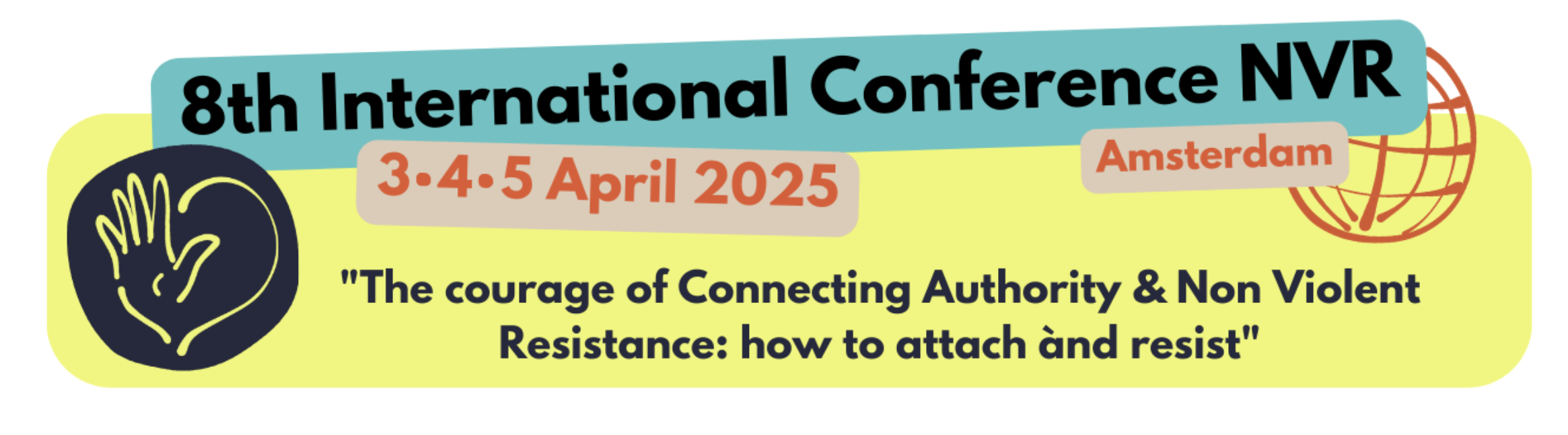
The 8th International Conference on Non Violent Resistance is being held in Amsterdam next April – 3rd, 4th and 5th. More information and registration details here.
Proposals for presentations are invited, deadline for submission is 15th September, and those accepted will receive a FREE place at the conference.
Filed under Announcements
The new Eastenders CPA storyline
It’s not the first time, of course, but that doesn’t stop the excitement when the issues surrounding child to parent violence and abuse (CPVA) are brought to greater public awareness through inclusion in a popular soap on TV or even the radio!
We’ve had Coronation Street in 2015, and Holby City in 2018 to name but two, and I was definitely convinced The Archers was touching on the issue when Jamie Perks started causing trouble around 2010; and now in 2024 we have an announcement that Eastenders will be featuring a storyline examining the relationship between Tommy Moon and Kat Slater over the course of the summer.
Continue readingFiled under Announcements, TV
Adult-Child to Parent Harm, Violence and Abuse: Parent and carer survey
I am pleased to post this request from Equality Collabs who have been commisioned by the Mayor’s Office for Police and Crime (MOPAC) to undertake research to enable better understanding around adult-child to parent harm, violence and abuse. The project focuses on the London area, but responses are welcomed from parents and carers around the country.
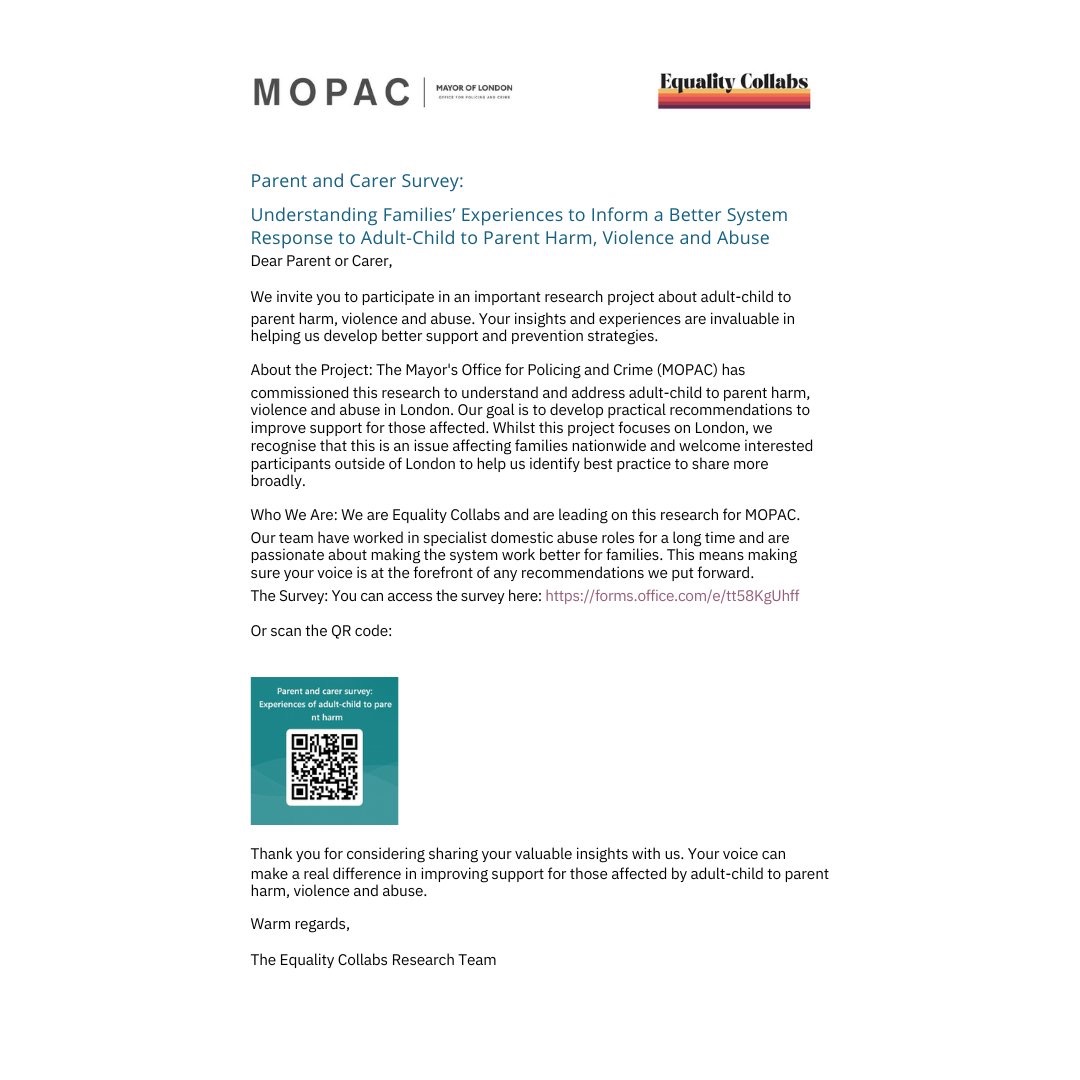
To take part in the survey you can scan the QR code above, or access the form via this link.
Filed under Announcements, Research
Starting from Scratch
What would be the first thing to do if you were starting from scratch?
Not the usual question I am asked. In the past it would have been “how much is there?”; more recently the enquirer would be asking for priorities from a list of recommendations. But I was meeting last week with Sarah Townsend, Principal Advisor to Te Puna Aonui, the New Zealand joint venture to improve the whole-of-government approach to family and sexual violence.
Continue readingFiled under Discussion

 HOLES IN THE WALL