This was a headline in the Sun newspaper last weekend, in an article by Michael Hamilton. Freedom of Information requests to 149 councils in England resulted in a figure of 62 children, ranging in age from 10 upwards, removed from their homes in 2015 by just 16 authorities. Some authorities refused to answer, citing data protection laws. The article lists the authorities which did respond and the relevant number in each case. The corresponding number for 2014 was 49. There are no other details, other than comments from an NSPCC spokesperson, recognising the impact of trauma on children’s behaviour and highlighting the need for help and support for families. Please assume my usual comments about the reliability of statistics such as these! Continue reading
Category Archives: Discussion
Soaring number of children being taken into care for abusing and beating up parents
Filed under Discussion, news reports
CPV: working across other communities
In one of those serendipitous ways this topic has cropped up in a lot of separate conversations recently so I thought I’d gather a few thoughts together.
I am indebted to Carole Williams, Parenting Officer in Ipswich and with many years experience as a Who’s in Charge? trainer, for her help in putting this piece together; and also to Cathy Press, Who’s in Charge? trainer, therapist and DA consultant with Awareness Matters, for her input. Although these comments come particularly from experience of working in group situations, many are relevant to one-to-one work also. Continue reading
Filed under Discussion
A parent campaigns for child to parent violence to be recognised in law.
A parent campaigning for recognition of child to parent violence and abuse within the legal system in the state of Florida, recently posted this video on youtube.
I am told that the animation was made with the full knowledge of the young person concerned, and that her mother, Heather, is keen that as many people view it and hear her story as possible. She would also like to hear from people who recognise her position and would like to join with her in lobbying the state legislature. Continue reading
Filed under Discussion, Film
I fear my son will kill me one day
This headline and the accompanying piece in the Family section of the Guardian last Saturday could not fail to shock those who came across it: a mother describing the terrible physical abuse she experiences at the hands of her teenage son.
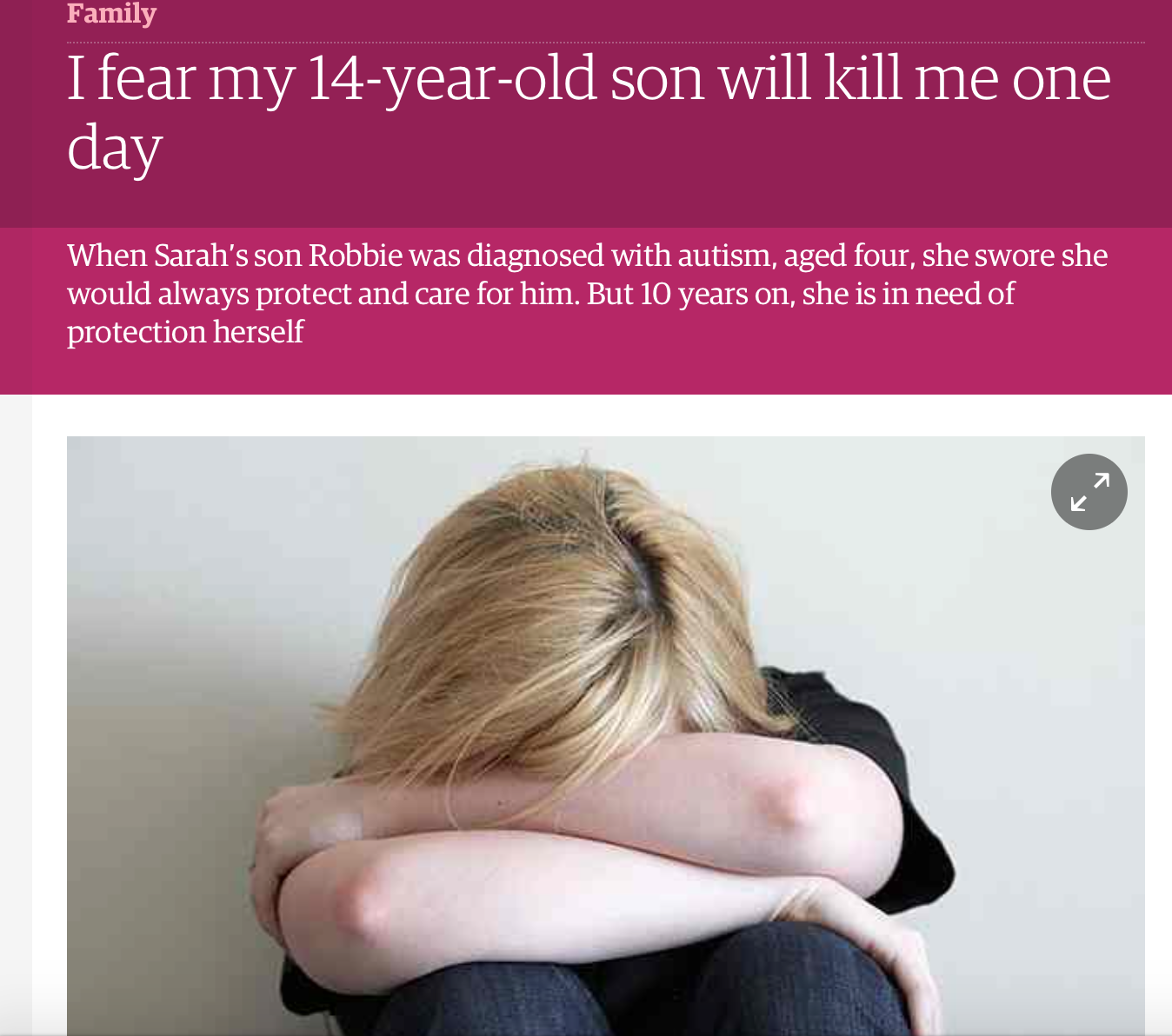
“Sarah” has found it almost impossible to admit that she is scared of her son, and yet when she first asked for help was told that it was unlikely she would get any – because he was loved and not in any danger. This reflects the prevailing story: that in a culture that separates children’s and adults’ needs and services, and focuses on the rescuing of children from danger, we fail to recognise the centrality of relationships in family lives, whether in their fragility of care or their strength to bring healing. Feeling undermined by professionals as much as by strangers and increasingly isolated at a time when their need for support on every level increases, the family is now offered 2 nights respite care every six weeks. Continue reading
Filed under Discussion, news reports
Child to parent violence, a background hum
Is it me, or have things quietened down a bit at the moment? Granted, I’m not on top of everything across the world, but in terms of big news making events we seem to be having a down period. How do we keep the momentum going in such a situation?
Personally I very much value the opportunity to talk through ideas, listen to those on the front line, apply learning and support each other. It’s also how we test theory, develop new work and highlight areas of need. Without comradeship and support, practitioners as well as parents can feel discouraged and isolated. And there is some quite discouraging news about as budget cuts within the Youth Offending Service in England and Wales take effect and CPV programmes are axed or subsumed into general work. But against this background there are other moves which are worth celebrating. Continue reading
Filed under Discussion
Royal Commission on Family Violence, 2016
“Of course I knew it was a very serious and extensive problem, but I don’t think I realised the dimensions and the scale of it“, the words of Justice Marcia Neave, who was the head of Australia’s first royal commission into family violence, which reported at the end of March, after a mammoth 13 months, during which the commission heard evidence from more than 200 stakeholders to come up with a final list of 227 recommendations. The commission was set up by the government of Victoria specifically, but the Victorian premier, Daniel Andrews, promised to accept every recommendation, and it is hoped that the federal government will also act in areas over which they have jurisdiction, such as the Family Law Act. Continue reading
Filed under Discussion, Policy
Happy Birthday, Holes in the Wall!
Please allow me a moment of self-indulgence as I celebrate 5 years of this website, Holes in the Wall, ‘born’ in May 2011 out of a desire to make a contribution to the understanding of children’s violence to parents, known sometimes as parent abuse. As a present to myself I have ordered shiny new postcards to leave with people at conferences and events, explaining how ‘Holes’ came about and how you can be part of the community!

Filed under Discussion
Be curious
Watching the most recent series from Channel 5 about child to parent violence recently, Violent Child, Desperate Parents, I’ve been struck by the principle underlying the therapist, Mandy Saligari’s work: Be Curious.
Read or listen to the discussions around the programme, or follow particular communities on twitter, and you’ll be familiar with the common assumptions about what’s behind the abuse. Parents too soft, giving them everything they want, they just need boundaries, parents have given up, the parents don’t give a damn. Of course, they do give a damn which is why they are taking the almighty step of exposing their lives to general opprobrium via this popular medium, but that seems to be overlooked. Continue reading
Filed under Discussion, TV
Parent Abuse: Gender issues in group work
Not a very snappy headline I’ll grant you but the alternative was too cheesey – “Keeping gender on the agenda”. Yeah, I know…..
While there are a small number of studies that have found little difference between the violence and abuse from young women and young men towards their parents, the general accumulation of research seems to point otherwise, and it is likely that this discrepancy can be accounted for by the type of survey, the type of data examined, the particular expression of violence or abuse, or the ages of the young people involved. Eddie Gallagher has a chapter on gender in his commentary on the literature regarding child to parent violence, and he confirms the experience of those involved in clinical practice or the legal world, as well as recent research in Oxford and Brighton, that boys are three or four more times as likely to be involved in CPV than are girls. This difference is most markedly shown as the age increases, and the level of violence worsens. This is not to deny that many girls and young women are extremely violent and abusive towards their parents; and Gallagher also suggests that their levels of violence may be increasing. Continue reading
Filed under Discussion

 HOLES IN THE WALL