The recent publication of the paper, Under the Radar: The Widespread use of ‘Out of Court Resolutions’ in Policing Domestic Violence and Abuse in the United Kingdom, by Westmarland, Johnson and McGlynn, once again draws attention to the differences between adult perpetrated DVA and child to parent violence. Continue reading
Category Archives: Discussion
Troubled families / Child to parent violence: some background thinking
Bear with me as I wander around thinking out loud here.
I recently attended the Centre for Crime and Justice Studies’ Troubled Families conference, in London.
Over the course of the day a number of eminent academics from across the fields of history, social policy, social work, sociology, economics, criminology and law presented papers on the origins, evaluation and policy context of the Troubled Families Programme. While the focus of the day was on the way that the Tory government had defined and presented a particular problem; and then gone on to provide a solution to it, regardless of evidence in either case, there was inevitably much to ponder in a more general sense, and much specifically relevant to work with child to parent violence. Continue reading
Filed under Discussion
Safe Lives Spotlight on Young People
The domestic violence and abuse charity, Safe Lives, have just launched their most recent Spotlight feature, which is about young people this time round, and which runs through to the end of March.
Safe Lives Research findings:
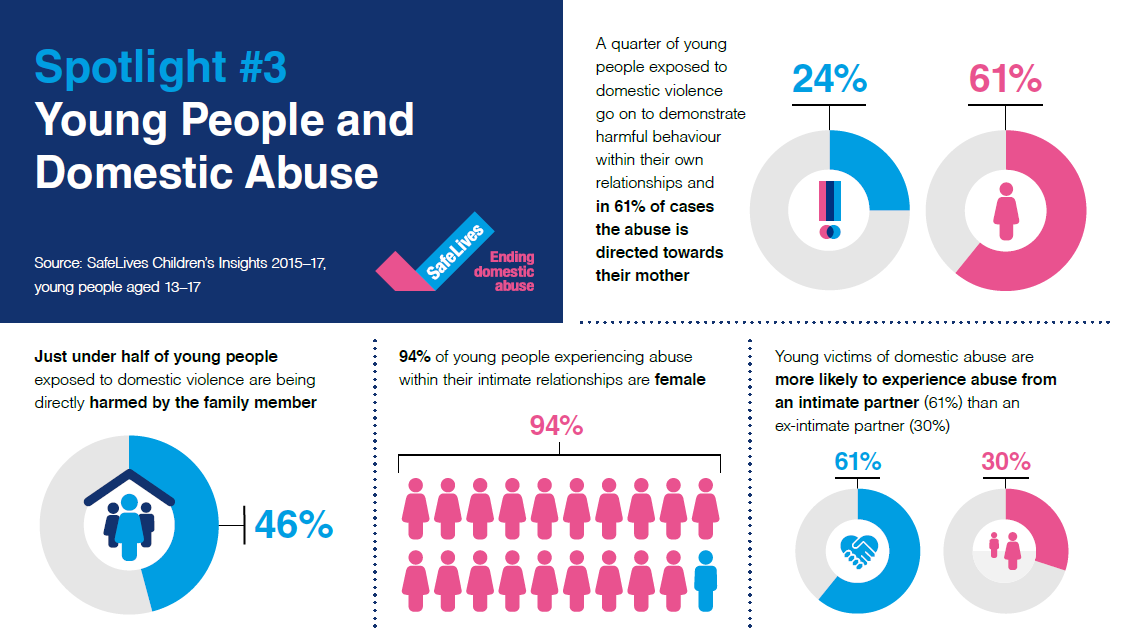
In the third of our Spotlights series (end of Jan – end of March), we’ll be focusing on the experiences of young people (13 to 17 years) affected by domestic abuse and the professionals who support them. We’ll be answering questions such as: how can professionals adapt to meet the needs of young people? How does a young person’s experience of domestic abuse differ to an adult’s? What are the best ways to support young people who harm without criminalising them?
Through a combination of blogs, short films and podcasts, we’ll be posting the latest research, practical resources for professionals, practitioner advice/guidance and talking to young people about their experiences. Be part of the conversation through our webinar on 3rd March from 1-2pm, and the Twitter Q&A on 17th March from 1-2pm – use the hashtag #SafeYoungLives.
There will be new content uploaded on the Safe Lives website each week, including discussions about violence and abuse from young people towards their parents and carers, so keep checking regularly. I will tweet further links as they go live!
Update, July 2017: Safe Lives have now published a report from the recent Spotlight event, entitled Safe Young Lives. You can read it here.
Filed under Discussion, Research
CPV survey: 1st impressions
At the end of November 2016, Al Coates, an adoptive parent and social worker, put out on social media a survey asking parents about their experience of child to parent violence. You can read more about it here and here. He received 264 responses over a three week period, largely – unsurprisingly given the main mode of dissemination – from adoptive parents. The collation started straight away and a first paper was put out at the start of the new year. First Impressions is available from the CE< website, part of the University of Sunderland. Dr Wendy Thorley, of the University of Sunderland, is a member of what might broadly be termed the Steering committee for this project, and she has helped to edit the report.
The survey asked questions about a family’s experience of child to parent violence, and about the age at which it started, the impact on the family, and about the help that had been offered – or not. Continue reading
Filed under Discussion, projects, Research
Adoption and Fostering Podcast, child to parent violence
I was privileged last week to have a conversation about child to parent violence (CPV) with Al Coates, adoptive parent, social worker and adoption expert, as part of his series of podcasts on the website Misadventures of an Adoptive Dad. Al has kindly allowed me to reblog the podcast here, but please do go over to his website and check out the other posts and interviews. The full version of his post can be found here. Al gives a thoughtful, informed and sometimes rawly honest account of fostering from both sides of the fence.
CPV is a big issue for many adopters (see the report : Beyond the Adoption Order), and it has been interesting to watch over the last couple of years as parents have gradually felt more at ease in discussing their experiences on line. It is important that these conversations continue in order to support one another, but crucially also so that other people hear the extent of the struggle, fear, anguish and exhaustion; and start to develop proper resources.
Filed under Discussion
Beyond Parental Control: no attribution of blame.
What happens when it is no longer safe for a child to remain at home? Sometimes children go to live with another family member, perhaps an absent parent, or a grandparent, aunt or uncle. I have heard of a young man going to live at his girlfriend’s parents’ house. These sorts of arrangements can work well, particularly if the violence and abuse is very specifically directed to only one person. But if it is more general, then the chances are it will re-emerge in the new home and this arrangement will also break down. Some young people may find themselves admitted to hospital where their risky behaviour is considered to be caused by mental ill health. Some may end up in youth custody as the result of a very serious assault. Others, perhaps the majority, will be taken in to the care of the local authority, whether as a voluntary agreement or on a care order, as “beyond parental control”. (Where you end up then seems sadly to be something of a lottery and must be the subject of future posts.) Continue reading
Filed under Discussion, Law
A story of knives and cuts – with a little bit of hope at the end.
What is it with knives? (I’m sure someone will answer that for us!) So many parents report the use of knives in the abuse they face from their children. I clearly remember a conversation with Julie Selwyn after publication of Beyond the Adoption Order, about the frequency that they had been mentioned in conversations with parents about their adoption journey. And I remember the horror in a friend’s voice as they described their early experience of fostering – which also marked the end of that venture for them. When people talk about being at “the sharp end” of a child’s anger, frustration and pain, this is too often what we are talking about. Continue reading
Filed under Discussion
Child to parent violence: Parents talking
On Sunday 28th August, Hannah Meadows posted on her website “But they look so innocent”: Our CPV experience – an account of living with traumatised primary aged children, and the family’s attempts to access help. The post was picked up by many people over the next couple of days, with significant twitter comments, and then also featured as a Mumsnet Blog of the Day. Hannah’s is by no means the only blog to raise the issue of child to parent violence in recent weeks. As schools returned, other parents spoke out about the stresses faced by their young people and the impact this has on mood, regulation and behaviour; and a quick tweet asking for contributions brought many other families and issues to my attention. Discussion ranged from the difficulties in being believed that there is a problem, professional understanding of the issues, lack of resources and the impact of budget cuts, the problem with “quick fixes” and being encouraged towards courses that are too brief, to what happens when misguided help makes things worse. Some of these issues are all too familiar, but others are important considerations which, perhaps, have not been sufficiently addressed in the past.
One of the people who replied to my comments was Scott Casson-Rennie, adoptive parent to three sons and Regional Manager in the Development Team (England) for Adoption UK. Scott, who tweets as @GayAdoption Dad, kindly agreed to contribute his thoughts and experience for this post. Continue reading
Filed under Discussion
One size doesn’t fit all
Some time ago I had a conversation with a parent of a child with an ASD diagnosis about the use of public care for both respite and therapeutic purposes, particularly when there has been violent and abusive behaviour towards parents present. Since then we have corresponded from time to time as media interest or legislative procedures have bobbed up and down.
The issue which initially brought us together was with regard to the need for specific understanding of the different and differing needs of neurologically atypical children and young people. We were concerned about a “One size fits all” approach in many aspects of support for families, and a shortage of specific training in neurological conditions for many engaging with families regularly in their work. We acknowledged that some conditions (such as PDA) had only recently been identified, but that other diagnoses were well known and well documented, so that there seemed little excuse for ignorance about the effects on mood and mental health, learning and employment opportunities, behaviour and offending. This parent had undertaken significant research into the diagnosis, communication with family, documentation and support for children and young people with ASD, and found that many went undiagnosed or their specific needs unrecognised, despite their over-representation within care and the juvenile justice system. Continue reading
Filed under Discussion
Oh! Can I have a quick word?
It started off almost as a throw away comment, made its way into a conference presentation, and now seems to have become a thing. So its definitely going in my book under “things not to say to parents”!
What we hear depends so much on where we are at that moment (emotionally and geographically), why we’re there, past experience, how distracted we are – before we even start on tone of voice, inflection or status of the person speaking. I thought I’d ask friends and family what they assumed if they heard that request. A quick straw poll came up wth the following responses and variations on the themes:
- Something must be very wrong
- Oh God, what I have I done now?
- It’s almost certainly not going to be quick!
- This is going to be bad news
- No, I absolutely don’t have time
I have every confidence that the person making the statement originally had the very best intentions, perhaps wanted to appear casual, to put someone at their ease even. That might work for some people (or there again, judging by the responses above, it might not).
If you are used to being called in to school for a child’s behaviour, if the police are regular visitors at your home, or if you are hiding something that is happening in your family because you are too ashamed to talk about it – child to parent violence for instance, then its not going to go so well. If we want to really work in partnership with parents, to help people feel valued and not ashamed, to encourage people to be open with us, then we need to choose our words extraordinarily carefully. Not just with comments like this one of course, but everything we say. We won’t always get it right. But if we start to think about it then that must be a good thing, yes?
(Bizarrely this article appeared in the Guardian this week, and seems to demonstrate clearly every possible way of alienating parents and preventing working in partnership!)
Filed under Discussion

 HOLES IN THE WALL