Once upon a time, when I didn’t know so much about “parent abuse” it seemed a little exciting to be at the forefront of a new phenomenon. It felt important to speak clearly and categorically, for clarity, and the avoidance of misunderstanding – which was commonplace. “Parent abuse? You mean abuse BY parents? No? You must mean older people then?” Now it seems that the more I learn, the less certain I am about anything – other than the fact that many, many more parents than we would like to think about are struggling daily with much, much more than anyone should ever have to face within their family. Continue reading
Tag Archives: Child to parent violence
“An Act Relating to Support for Parental Victims of Child Domestic Violence”
Fantastic news this week from Florida, where Alice Flowers has been campaigning for legislation in this field, since the tragic death of her sister.
FL HB 1199 makes the requirement for Support for Parental Victims of Child Domestic Violence; Requires DJJ, in collaboration with specified organizations, to develop & maintain updated information & materials regarding specified services & resources; requires department to make information & materials available through specified means; requires domestic violence training for law enforcement officers to include training concerning child-to-parent cases.
After the bill was passed unanimously in the Florida Senate, it passed to the House of Representatives, where it was sponsored by District 45 State Representative, Kamia Brown. The final vote on May 3rd was again unopposed, and it now goes to be signed by the Governor, Rick Scott, after which it will be enacted on July 1st. Florida then becomes the first state in the United States to recognise child to parent violence. Continue reading
Filed under Law
Child to parent violence: Realities, Enigmas and Ambiguities
A number of new papers – academic and discussion – have been published recently, and I have gathered them all up here together for ease. Continue reading
Filed under publications, Research
Child on Parent Violence – DfE Expert Advisory Group
With permission, I am reblogging this post by Al Coates, from his site: Misadventures of an Adoptive Dad. (Wednesday March 29th 2017). Al is a member of the DfE Advisory Group on fostering and adoption, and has been instrumental in bringing the issue of child to parent violence to the attention of the Department.

It was the quarterly Department for Education’s Expert Advisory Group on Adoption Support. Today was the usual updates on this and that and a few larger issues addressed such as the working out of the role of the Virtual School Heads. We focused to how the Adoption Support Fund was progressing, of course there are challenges but to date nearly 18,000 children had been helped and that the fair access limit remained above the average cost of the vast majority of applications. No help if you’re over with match funding and a difficult issue for some but 80 families have been match funded, which is more than I’d envisaged.
We had a discussion around the incoming legislation of the Virtual School Heads with NAVSH represented in the room they gave a good account of how they envisaged it playing on the ground. It is was a good discussion and there’s room for encouragement and optimism. Of course there are uncertainties as we move into new responsibilities and grey areas but without doubt we are heading in the right direction, it would have been nice to have heard Gareth Marr’s thoughts as we discussed the role.
The final item on the agenda was Child on Parent Violence, I’d asked for it to be there.
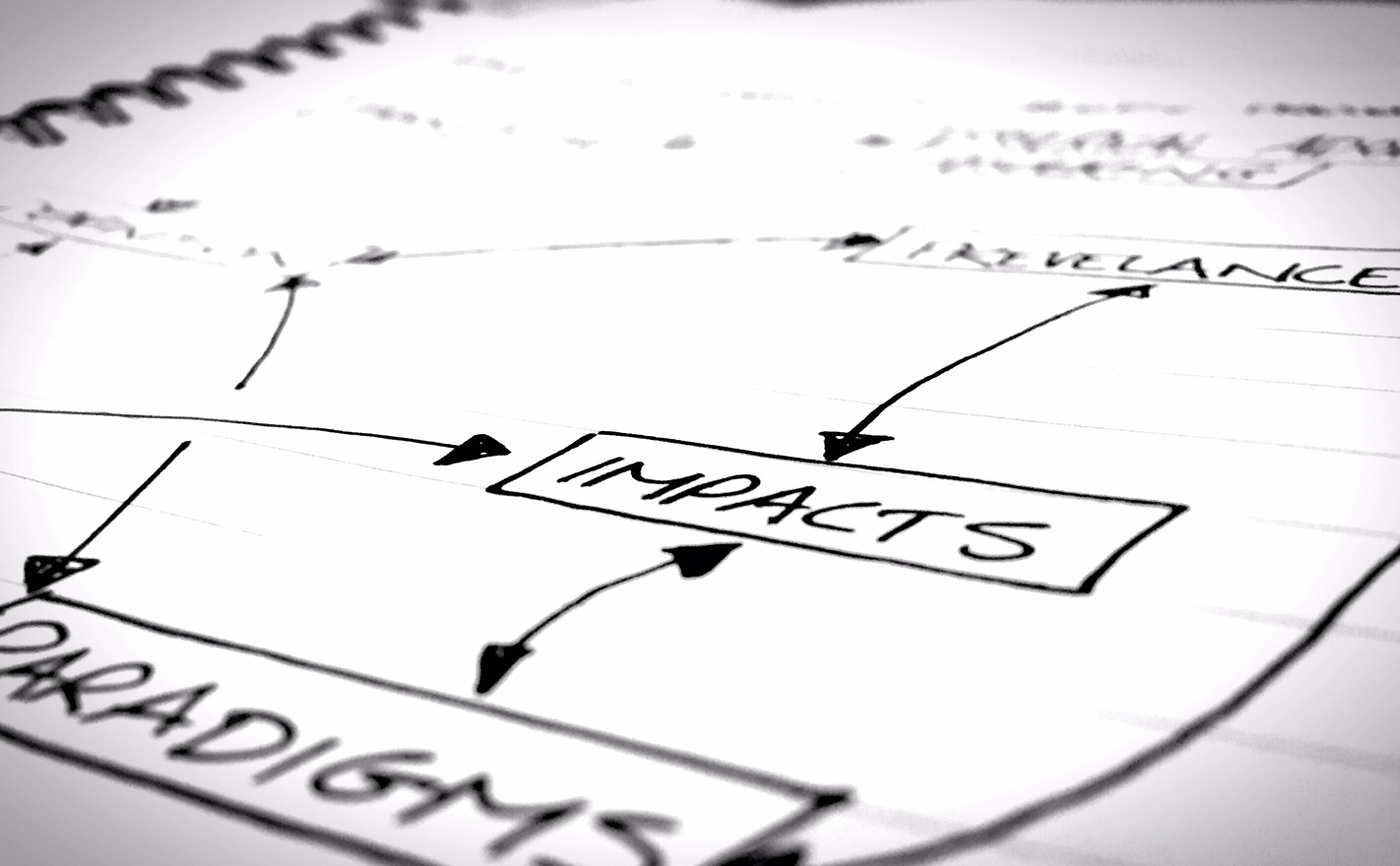 |
Drawing tougher all the findings from the Survey that I’d undertaken and the subsequent findings that Dr Wendy Thorley had made sense of in the first and second CPV reports that laid it all out. It’s too much go through verbatim and a text version of a 45 minute presentation is too much to bear so here we go in eight words.
Taboo (fear of response, isolation, criminalisation, ignorance, stigma, victim blaming)
Paradigms (different professionals view it very differently
Definitions (the trouble with them)
Causes (complicated)
Prevalence (lots, 30% ish)
Impacts (massive)
Responses (shocking)
Actions
Paradigms (different professionals view it very differently
Definitions (the trouble with them)
Causes (complicated)
Prevalence (lots, 30% ish)
Impacts (massive)
Responses (shocking)
Actions
It was well received, they’re a polite bunch, but I do think the collective minds and organisations in the room took the message to heart.
Child on Parent Violence is a ‘thing.*
This is a thing that we need to act on, a complicated, ugly, painful and prickly thing that needs to be grasped. As one member noted, not a can of worms but a bucket of worms.
Actions is the interesting bit, so what do we do next?
That’s the question, what do we do with this ‘thing’, first we call it a thing and we start to raise awareness and we start to consider if this as big as we suspect and believe that we make it a part of Social Workers Continual Professional Development.
We consider how we prepare adopters to let them know it’s a ‘thing’ and it’s ok to say it’s happening.
We liaise with safeguarding and tell them about this ‘thing’.
We develop out knowledge of interventions and what works in a real world situation.
The DfE are going to talk to the Chief Social Worker about their views and knowledge.
Today felt like a start line not and maybe a consideration of what may be the first steps in removing the taboo and developing the culture that makes it ok to ask for help and ok to say you’re not ok.
I apologise that this is all a bit vague, it’s late and having thought hard about this for a long long time and lived to varying degrees with it and in it. I feel very sleepy all of a sudden.
On another note I’m thinking of getting the presentation, with other stuff, out to a wider audience and there’s even talk of putting on a free event for whoever’s interested and recording it, podcasting and you tubing it. I’m pondering that thought so if that’s of interest let me know.
All in all a good day.
*Speaking to a group of Social Workers last week a senior practitioner said “We knew that this happened but we didn’t realise it was a ‘thing’.”
If you have found this of interest then please do check out other posts on Al’s site.
Filed under Discussion
CPV: So what does it look like, Part 1.
This is a post I have had in mind for a while, and which has been changing shape faster than I can write. As a result, this is going to be part 1, and I will continue the discussion over the next weeks and months. It really develops two themes and questions: what are we actually talking about when we present training or speak about child to parent violence (CPV); and where are the edges of the definition – what’s included, who’s included, and what and who’s not? It is something we need to address. I am often asked for examples to illustrate a discussion or seminar. It is lazy to simply assume that people understand the concept just because we have become familiar with it. “The outside world find it hard to imagine. As a mother you don’t broadcast it to the outside world because its not something you’re particularly proud of.” (Rosie Noble) But as more and more people start to speak out and to use the phrase “child to parent violence” it inevitably stretches a bit at the edges.
Many years ago now – by CPV standards – Eddie Gallagher gave a handy list of the types of family situation that might be affected (in his experience) by child to parent violence. Since then the list has grown, and it inevitably includes examples that make us a bit squeamish in including them under an official definition: severely disabled children for instance, or those acting in self defence. I have sometimes pondered how parents themselves feel about including themselves in a CPV definition. Indeed, I have asked parents of children with ASD whether they feel it is appropriate to their situation. Is that how they experience the situation? Do they feel they need to protect their child by rejecting the definition? Are the types of help currently available completely inappropriate to their situation and so it does not seem to include them? I meet parents of children with a learning disability who describe persistent and escalating levels of violence and abuse, that in many ways matches the experience of families with adopted children, or families who have experienced domestic violence, or with mental ill health. And of course in each situation there may be layer upon layer to consider. There is rarely one clear cause or trigger, and for each family it will look and feel slightly different.
Is it taboo to admit your child with disabilities hits or bites you? On Woman’s Hour, on February 21st, Jane Garvey introduced a segment about caring for a child with disabilities. You can hear the programme here, and the discussion lasts from the start to 25 minutes in. There are interviews with Nikita, parent of a five year old child, Nayan, with microcephaly, who shows tremendous resilience in the face of regular tantrums and lashing out which comes from frustration; with Rosie Noble, Family Support Manager at Contact a Family, who offers reassurance that things can get better; and with Yvonne Newbold, mother of Toby, who has written extensively about caring for a child with disability. Yvonne has since blogged about the experience of appearing on the programme, and about her decision to speak out. I highly recommend her blog both for the honesty of the encounter, and for information about Yvonne’s wider campaigning to improve support for families experiencing long term, significant levels of violence from their learning disabled children. I’m not going to repeat the details here. If you are interested in knowing more about Yvonne’s experience then please do check out her website. She has organised a groundbreaking conference for the coming weekend, following her Woman’s Hour appearance, and I hope to post more information about her campaigning in the coming weeks.
For what it’s worth, I don’t think Nikita’s situation would be included by many people within a CPV definition. That is not to diminish the level of violence she and her husband face – and sadly may continue to experience, but to question the level of control or intent involved in the hitting and lashing out. But how will we feel as Nayan becomes older, bigger and stronger? What about Yvonne and Toby – how is their situation different? Is it different? The issue of intent is one I will return to in later posts, as it seems to be a central part of the conversation, and yet raises more questions than it answers.
If that’s not enough questions, I want to conclude by drawing some thoughts together and throwing a final one out there for discussion.
When we discuss child to parent violence we are not talking about the odd push or shove, about stroppy teenagers, or about an argument we once had that got out of hand. The phrase is used to describe a pattern of persistent and often escalating violence and abuse over perhaps years, from a child or young person towards their parent or carer. The routes to CPV are many and varied, and frequently overlapping. Each family situation is unique, and yet there are many commonalities, not least in the actual day to day experience and damage – physical and emotional that is done. Nikita describes the pain and hope of living with a disabled child. Yvonne has years of experience and has taken a decision to break the silence, to encourage others to speak out, and to campaign for better support. These are just two examples of what CPV might look and feel like.
So my question(s): Does that help your understanding or does it complicate it? And if you have a disabled child yourself, how do you feel about being included within the definition of child to parent violence? As always, please do join in the conversation!
May 3rd 2017: I’m adding on a bit here rather than starting a new post, because I think it furthers these particular thoughts.
Yvonne Newbold has continued to add to her own website over the last weeks, and this includes a page about dealing with violent and challenging behaviour from children and young people with neuro-disabilities. I think it is significant that Yvonne chooses to use this phrase – VCB rather than CPV – in this situation.
Filed under Discussion
The use of restorative work in CPV: where it diverges with IPV
The recent publication of the paper, Under the Radar: The Widespread use of ‘Out of Court Resolutions’ in Policing Domestic Violence and Abuse in the United Kingdom, by Westmarland, Johnson and McGlynn, once again draws attention to the differences between adult perpetrated DVA and child to parent violence. Continue reading
Filed under Discussion
Domestic violence isn’t always between adult partners
If you’ve not come across child to parent violence before; if you don’t know anyone affected; it’s easy to misread the signs. Sadly, we have come to accept that adults can experience intimate partner violence. Folk may not all fully understand what is going on and why, but they get that it happens. So when you hear shouting and screaming noises through the wall from the neighbours, or when you see bruises, it would be natural to draw that conclusion.

Filed under TV and video
Troubled families / Child to parent violence: some background thinking
Bear with me as I wander around thinking out loud here.
I recently attended the Centre for Crime and Justice Studies’ Troubled Families conference, in London.
Over the course of the day a number of eminent academics from across the fields of history, social policy, social work, sociology, economics, criminology and law presented papers on the origins, evaluation and policy context of the Troubled Families Programme. While the focus of the day was on the way that the Tory government had defined and presented a particular problem; and then gone on to provide a solution to it, regardless of evidence in either case, there was inevitably much to ponder in a more general sense, and much specifically relevant to work with child to parent violence. Continue reading
Filed under Discussion
A National Survey for Adoptive Parents: The Reality of Physical Restraint
This is an issue that has raised its head a lot recently in connection with child to parent violence, and about which The Open Nest charity has already developed significant resources. This fact finding survey is circulated for all adoptive parents in Britain and closes at the end of February.
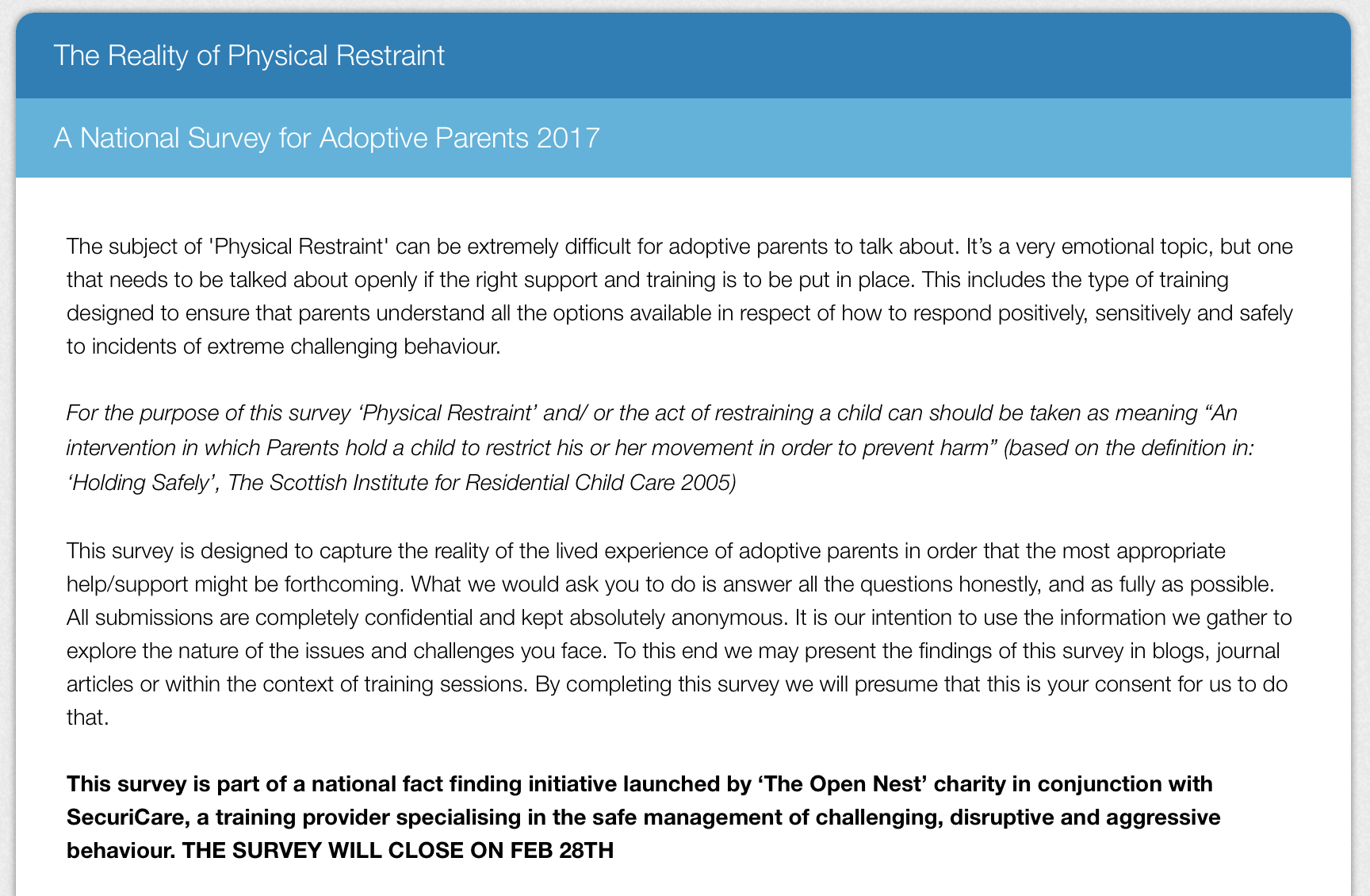
The survey is now closed and I have been asked by the organisers to pass on thanks to all who took part: “Many thanks to everyone who supported and/or completed the recent restraint survey examining the experience of adoptive parents. The findings will be published once collated, and I will make contact with those who expressed a willingness to participate in follow up interviews in due course” – Lee Hollins PGCert Health Research, BSc (Hons)
Filed under Research
CPV survey: 1st impressions
At the end of November 2016, Al Coates, an adoptive parent and social worker, put out on social media a survey asking parents about their experience of child to parent violence. You can read more about it here and here. He received 264 responses over a three week period, largely – unsurprisingly given the main mode of dissemination – from adoptive parents. The collation started straight away and a first paper was put out at the start of the new year. First Impressions is available from the CE< website, part of the University of Sunderland. Dr Wendy Thorley, of the University of Sunderland, is a member of what might broadly be termed the Steering committee for this project, and she has helped to edit the report.
The survey asked questions about a family’s experience of child to parent violence, and about the age at which it started, the impact on the family, and about the help that had been offered – or not. Continue reading
Filed under Discussion, projects, Research