I heard this week some wonderfully encouraging news from a family in Canada who had been in touch some years ago looking for help and advice concerning the daughter’s use of violence in the home. At that time they had no hope that they would find someone who understood their experience, or would be able to offer the therapeutic help their family so desperately needed. Through their perseverance and determination, they have not only secured help for themselves, but also worked towards developing understanding and support for many other families experiencing child to parent violence across Canada. I would like to share the blog post they have written for the Mental Health Commission of Canada, and to bring hope, perhaps, to other families by doing so.
We talk a lot about how child to parent violence and abuse disproportionately affects women – citing the ‘availability’ of mothers because of their particular caring responsibilities, and the societal messages that young people pick up. We talk about more boys than girls, and more young men than young women, using harmful behaviours – and indeed their behaviour being perceived as more harmful, or more likely to bring them to the attention of the police. These are real issues and ones which deserve our attention and our consideration.
The Home Office launched a set of 7 over arching principles and practice guidelines yesterday, January 9th, to support the commissioning and delivery of services in domestic abuse perpetrator work. The Standards centre the enhanced safety and freedom of all victim-survivors, including children, and are based on evidence of what has been shown to be important and effective through an evaluation of the available literature and consultation with stakeholders. The report was written by Professor Nicole Westmarland and Professor Liz Kelly. I was privileged to be part of the supporting group.
But what does this have to do with child and adolescent to parent abuse you might ask.
Sometimes life doesn’t play out the way you hoped – or planned. For those living with children who use behaviour to express hurt, distress or anger, the reality can turn out to be very different. Those working in this field are getting hold of this idea properly and in that respect it’s been a good year – more awareness, more research, more funding and provision. But the truth remains that there is a long way still to go before everyone who needs it has access early on to support, in order to understand what is happening in their family and to make things safer and happier.
But I have to live in hope, however hard; and so I wish every family and everyone touched by CPV some hope for the new year. This time of year can feel very dark (in the northern hemisphere at least) but the light will grow stronger over the weeks ahead!
For myself, I look forward to continuing to build networks: to connect all those with an interest and curiosity; to linking up professionals and policy-makers to bring about system change; to bringing together people across continents to learn from eachother. This is your invitation to join the party! Get in touch. Tell us about your work. Share your own hopes and dreams. We cannot make the change on our own, but together we can do great things!
If you need help over the Christmas period, many services will have shorter hours and are closed some days. If you feel in danger then always consider calling the police or mental health services. Family Lives are closed 23rd – 27th December and 31st to 2nd January. The Samaritans will be open all over the holiday.
It’s been fantastic to see so much attention given to organisations supporting families living with child to parent violence of late. PEGS have featured in a number of awards in the last weeks, and yesterday this one in Canada caught my attention.
Congratulations to Maude Champagne for winning the Mitacs Award for Outstanding Innovation!
Judith Smith, who recently published the book Difficult, Mothering Challenging Adult Children Through Conflict and Change, is running a series of webinars for parents specifically, starting November 10th. The details are all on this message from her. Please note that the webinars are at 7.30 pm Eastern Standard Time. See further down for details of Support Groups starting February 2023.
For as long as we have been writing and talking about children’s violence towards parents, there has been a sense of frustration that there is not better data available to inform research and practice. We have even looked at ways to include questions in the Crime Survey – so how could I pass by an opportunity to publicise this latest piece of research!
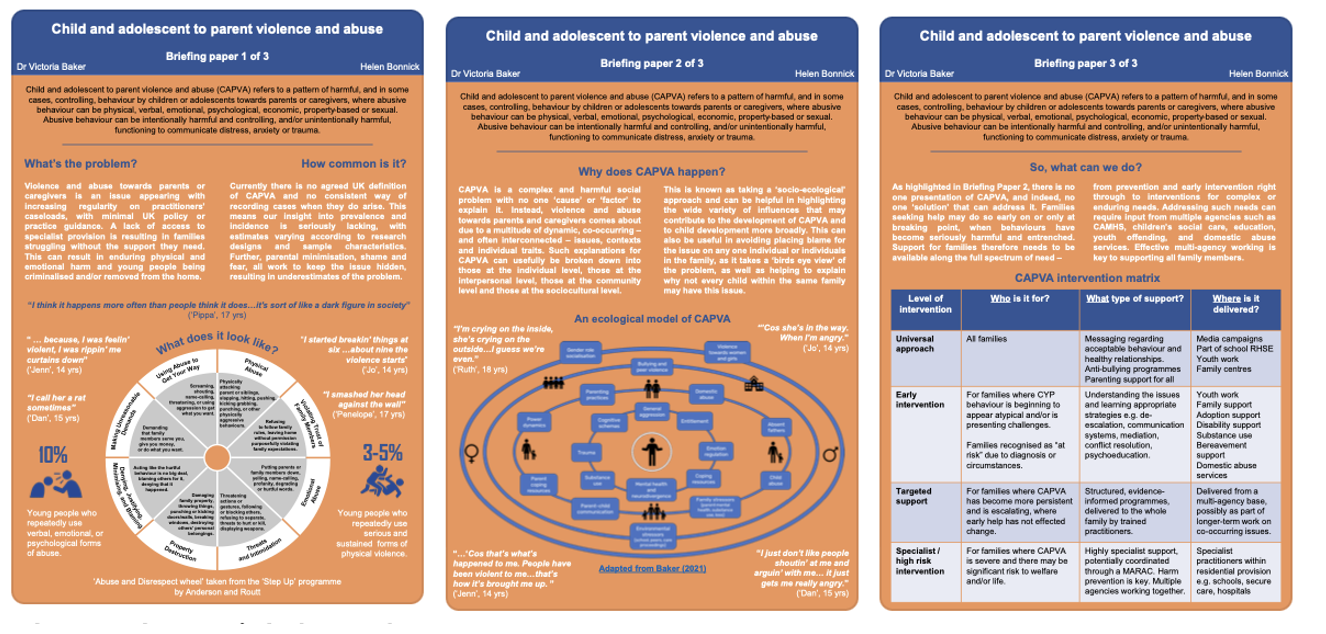
I am absolutely delighted to finally launch a series of Briefing Papers on the topic of child and adolescent to parent violence and abuse (CAPVA), which I have had in mind to create for over 5 years, and which Vicky Baker has now most wonderfully helped to bring to realisation over the last few months!
Briefing Papers 1, 2 and 3 (front pages only)
The idea grew from an increasing number of calls to discuss a range of particular angles on child and adolescent to parent violence and abuse, but which inevitably began with a half hour spent explaining what we were talking about before getting down to the meat of the conversation. It was clear that there was a space for a succinct overview of the main issues to do with CAPVA in a way that could be digested in a short space of time, and that would be equally helpful for anyone coming to this issue fresh – whether as a practitioner, a commissioner, a journalist, or indeed as a politician.
Working together with the benefit of having recently completed the rapid literature review for the Domestic Abuse Commissioner, with a wealth of knowledge from Vicky’s PhD studies, and with the background of many years listening to people about their experience and work, we have written 3 separate papers, each with three pages, explaining in turn what we mean by the term child and adolescent to parent violence and abuse, why it happens, and what can be done to support families
The finished 3 papers are free* to download, and we hope that you will feel able to share them widely with colleagues and even to use them in your own work as the need arises.
Inevitably, with a topic about which we continue to learn on a daily basis, they will need updating as ideas evolve and understanding develops, and so you are encouraged to offer comments and feedback. Let us know if they have been useful, how they were used, what else would have been good – bearing in mind that if they get much larger they will cease to be briefing sheets and will be a book instead!
A massive thank you to Vicky for all the work she put in to these. They honestly would never have happened without her.
Download Briefing Paper 1: What’s the Problem?here
Download Briefing Paper 2: Why does CAPVA happen? here
Download Briefing Paper 3: So what can we do? here
* Some people have suggested we should be charging for these. We have decided to keep them entirely free to download and we hope many people will do so. However, if you would prefer to make a monetary contribution, then please feel free to donate to a local charity supporting families suffering any type of abuse.
I wonder whether it is a peculiarly British thing that we have taken so long to decide on both a name and a definition? There is the need to be inclusive and not to offend, but also a strong sense of digging in of heels at times! Which is perhaps how come we still have both a myriad of letters and words for this type of harmful behaviour, and a lack of agreement on who to include, whether it is one phenomenon or many, whether they need to be distinguished within a typology – and most recently – what the upper age range might be.
Of all the reasons that have been given for making sure we agree terminology in work in the area of child to parent violence and abuse, the one that stands out for me is that families, practitioners and policy makers all need to share – and own – the language used. If not, then we risk losing people along the way, unable to access help or to adequately explain their experience. A couple of different initials and we have lost a load of data. Failing to agree and we start to look like a divided community.


 HOLES IN THE WALL