Tag Archives: harmful behaviour

CPV: The podcast special

How do you consume your podcasts?

On the way to work on the train? Walking the dog? While you’re doing the ironing? Or do you find a quiet half hour to focus solely on the content? However you find the time, there are some great podcasts out the at the moment, focussing either specifically on children using harmful behaviour towards parents – CPV – or on different approaches to working with families to bring about a more healthy and hopeful life. These may be directed first and foremost towards professionals – offering guidance for work with families, or they may offer tips and strategies directly to those affected. Whatever you are looking for, they all remind us that this is something that is more prevalent than we might have imagined previously, but that there is hope when you find the right people who know their stuff!

By no means a definitive list, but here is a selection of some of the top podcasts regarding CPV.
The Adoption and Fostering podcast is now in its 9th year, with nearly 200 episodes in the library. Al Coates and Scott Casson-Rennie discuss a range of issues related to contemporary adoption and fostering, often with special guests. Many of the episodes touch on children’s aggressive behaviour towards parents and carers. A fair number focus on this issue specifically. While this is labelled as adoption and fostering, many in other fields will find topics of relevance.
Capa First Response launched Series 1 of their podcasts in early 2024 and already have a second series ready to go. Series 1 features conversations between founder Jane Griffiths, Senior Practitioner Matt Rider, and patron Helen Bonnick, and touched on more general issues regarding child to parent violence and abuse which come up frequently in discussion, while the next episodes will address more specific topics such as neurodiversity. There is a third series in the planning stage.
The NVR podcast is aimed both at professionals and families, with experts in the field discussing strategies, the rationale behind this way of working, and case studies amongst other things. Non-Violent Resistance (NVR) has a proven track record for work with families who have experienced trauma, and looks at ways to de-escalate a situation and build a supportive network around the family. Peter Jakob, Shila Desai, Jill Lubienski and Rachael Aylmer chat together and bring in special guests. The applications are broad, but again, many will touch on families where children are using violence and aggression, or where there are similar overlapping issues.
Sarah Fisher is an NVR practitioner who developed Connective Family, a practice supporting families where children are exhibiting challenging behaviour. Her podcasts are often shorter than others but full of down to earth advice and quick tips for busy families.
Interwoven Connections is a Canadian Organisation supporting ‘the tapestry of families and relationships formed through adoption, kinship and customary care’, particularly where children are using harmful behaviours towards parents and carers. They have a library of resources for parents including webinars and podcasts.

There are of course many other resources as well as these listed. You will find some listed on the Sound and Vision page, but I would also invite comments if you have suggestions of other relevant podcasts which have been helpful to you and which you can recommend to others on this subject!
Leave a comment

Filed under Discussion, Family life, podcasts

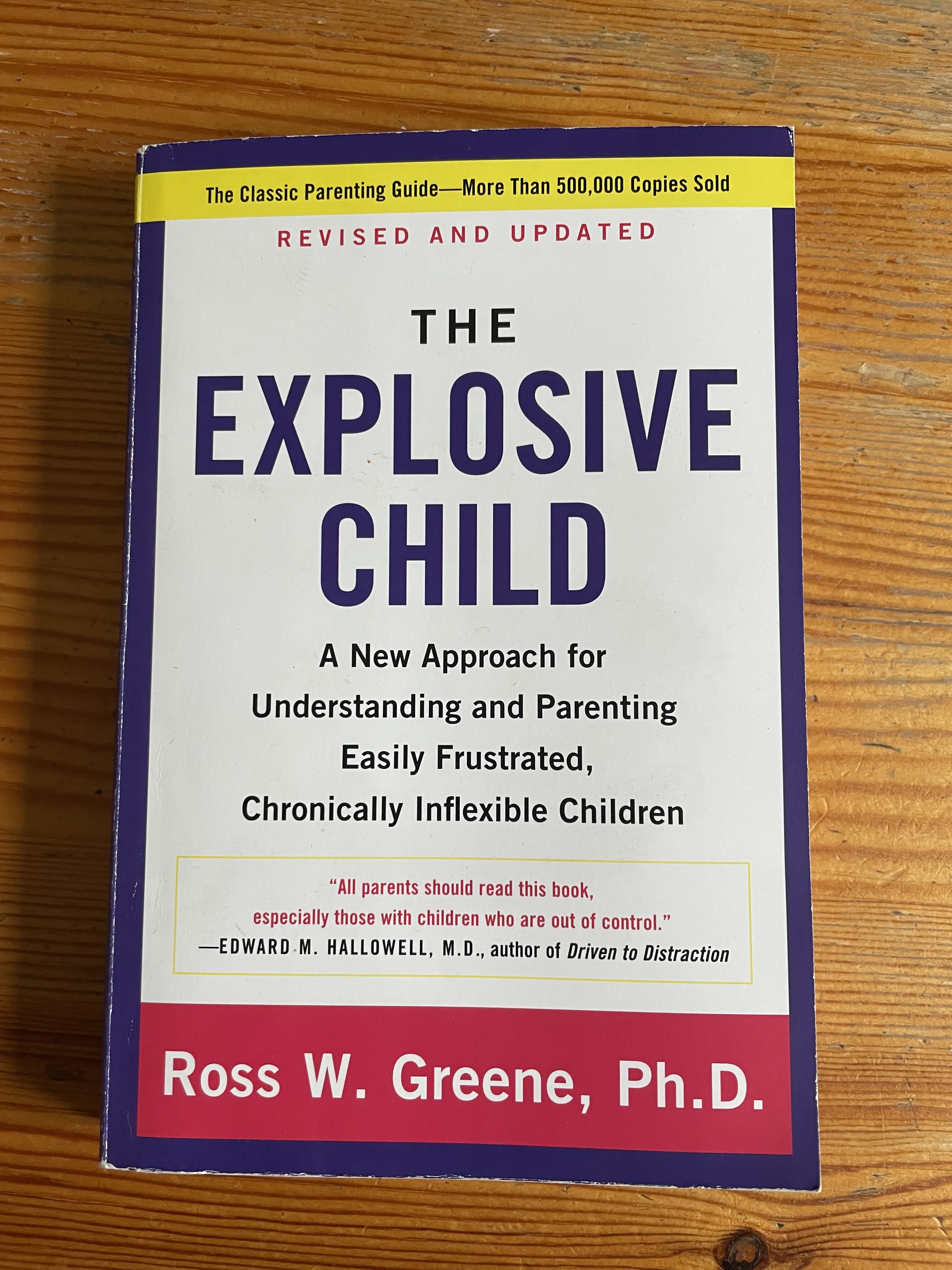
A new way of thinking: The Explosive Child

I was first recommended this book by Kate Iwi in 2018, and reminded of it again reading the recent paper from Nikki Rutter.

Greene offers a new way of thinking about “behaviourally challenging children”, and about their parents, which prompts a different response to their behaviour from the adults around them. While he uses the term ‘Explosive’ in the title, he admits to being a little unhappy with it as he finds the challenging behaviour to be often predictable, and also often ‘implosive’. Nevertheless, it will chime with many families, who will recognise the behaviours described within its pages. Greene lays out ‘Plan B’ in easily digestible steps as a way forward in the journey to restoring peace and safety in the home. With many examples both of the behaviour, and scripts to follow, this is a book that you could comfortably read in a couple of sessions – but don’t! With resources to download and homework to do you will be referring to this over a longer period of time.

Continue reading

Leave a comment

Filed under Book review, Discussion

Finding the right words: what I meant

We often think about the language we use in work with families where there is harmful behaviour from children, but more usually in terms of what we call it (see this sentence!) or the terms we use to describe the various family members involved. This week I have been reflecting on the difficulties that arise when the language we use as professionals is different to that used by parents. I have written about this before, and included a reference in my book to a blog by Raising Devon where the author talks about the difficulties in getting help while she referred to her child’s behaviour as “tantrums” rather than “rages”.

Continue reading

Leave a comment

Filed under Discussion

Deprivation of Liberty stories

Summer is the time that I catch up on reading all the research papers and news articles that I have been storing on my laptop; and so I have finally found the space to pull some thoughts together. One thing that has particularly caught my eye over the last months has been the reporting on the rise in the number of vulnerable young people subject to Deprivation of Liberty (DoL) Orders.  

Children and Young People Now has run a number of articles about this, examining the reasons for the sharp rise in orders (here), and analysing the growing gap in secure care provision (here), and in this piece from the beginning of August, looking at the impact on the young people themselves, often placed at great distance from their families and support systems, in unsuitable accommodation and in situations likely to increase their trauma and vulnerability rather than aid their recovery. 

Continue reading

Leave a comment

Filed under Discussion, Law

#CPVA What about the Men?

We talk a lot about how child to parent violence and abuse disproportionately affects women – citing the ‘availability’ of mothers because of their particular caring responsibilities, and the societal messages that young people pick up. We talk about more boys than girls, and more young men than young women, using harmful behaviours – and indeed their behaviour being perceived as more harmful, or more likely to bring them to the attention of the police. These are real issues and ones which deserve our attention and our consideration.

Continue reading

Leave a comment

Filed under Discussion

Statutory Guidance to the Domestic Abuse Act published

At the start of the month, the Government published the Statutory Guidance to the Domestic Abuse Act 2021, taking into account the results of the consultation process which took place in the latter part of last year. The guidance document is intended to “to increase awareness and inform the response to domestic abuse. It also conveys standards and promotes best practice.” The various chapters consider an understanding of domestic abuse, recognising domestic abuse, the impact on those involved, the different needs and circumstances of individuals affected, and agency responses – whether individually or as part of multi-agency groupings. While the vast majority of the document deals with abuse perpetrated by adults, it is important that there is also included the issue of young people’s harmful behaviour, whether towards their peers, or towards their parents / carers.

Continue reading

1 Comment

Filed under Law, Policy