Tag Archives: politics

Outcomes in Australia

For our next blog in the International Perspectives series, we are very privileged to hear from Karalyn Davies, Senior Project Officer at the Centre for Excellence in Child and Family Welfare.

As I finish up what is nearly six years of working on this topic, I thought it might be timely to write a reflection summarising the key lessons we’ve learned from our conversations with specialist adolescent violence practitioners and researchers based here in Australia.

For context, the Centre for Excellence in Child and Family Welfare (the Centre) is the peak body for the Child and Family Services sector in two Australian states, Victoria and Tasmania, and has been championing children’s rights for more than 100 years.

Back in 2016, Victoria’s Royal Commission into Family Violence[i] recommended that adolescent violence against parents and carers requires a developmentally appropriate response, distinct from adults. By 2019, there was a growing number of specialist ‘adolescent/young person violence in the home’ (AVITH) programs, and the Centre was funded by the Victorian Government to identify, translate and embed research and practice expertise and strengthen the knowledge base on AVITH. Today, Victoria has an established specialised service system for work with young people aged 12-18 using violence, with programs covering each of the 28 human service regions throughout Victoria. These services are all funded to use relational, whole-of-family approaches, rather than focusing solely on ‘fixing’ the young person’s behaviours.

Estimating prevalence of AVITH is a tricky undertaking. Shame and stigma discourages parents/carers from seeking help[ii]. A 2022 study surveyed 5000 Australian young people (aged 16-20 years) and found one in five had used violence in the home.[iii] Research shows it is predominantly sole mothers and female caregivers who are harmed by young person violence.[iv] Despite this, young people of all genders might use violence in the home, not only those identifying as boys or young men. Some specialist service providers report almost half of their referrals are for girls using violence. The average age of these behaviours starting is 11 years,[v] and practitioners report referrals for children as young as 8 years. In 2020, the groundbreaking PIPA Report[vi] highlighted that any intervention which responds specifically to AVITH is likely ’coming 10 years too late’.

Language matters

We have learned that language matters because the way we think and talk about an issue influences how we respond – in our interactions with the family, in the types of support and interventions we use, and in how we collaborate with other service systems. Our legal systems recognise the term ‘perpetrator’ as someone who chooses to use a pattern of harmful, coercive or controlling behaviours[vii] and someone who rightly needs to be held to account for their actions and possibly removed (forcibly and/or via legal means) from living with people they are harming. Yet we know anecdotally and from research (see, for example, Burck[viii]) language referring to young people being ‘perpetrators’ or using ‘family violence’ contributes to feelings of shame and leads to disengagement for families. For First Nations families, language about perpetration or victimhood can be retraumatising.[ix] Specialist programs for young people in Victoria have now shifted to using ‘AVITH’, and have removed any mention of ‘violence’ from their program names.

An evolving understanding

Over the past few years, there has been a concerted effort in Australia to build our understanding of AVITH and our network of professionals who support families. The following points reflect this increased awareness:

  • An Australian study found that the strongest predictor of a young person using violence in the home is their own experience of violence, with nearly 90 per cent of the sample (n=5000) having experienced violence and/or maltreatment.[x] This means that in cases where violence or abuse has occurred, our service system needs to act early and proactively rather than wait for behaviours to escalate.
  • Research from Queensland, a north–eastern state in Australia, shows that for young people who have experienced violence, it is not necessarily the modelling of violence which leads to AVITH. Trauma, attachment and compromised parenting are all more directly linked,[xi] signposting key intervention strategies.

  • There appears to be a high prevalence of neurodivergence among young people using violence in the home – practitioners report up to 80 per cent of their caseloads involve children with ASD or ADHD. Yet there is no clear practice guidance for this cohort, and practitioners consistently rank neurodivergence as the area where they feel least confident. Popular training and resources at the Centre this year have been on the topic of reframing young person violence with a neuroaffirmative lens.
  • Cases of AVITH are further complicated if the young person and/or parents and carers have been using alcohol or substances, suggesting the need for screening at the point of service intake.[xii]
  • Working with children and young people who use violence requires a more nuanced response than programs targeted at adult users of violence. An evidence-led approach recognises distinct neurobiological and socioemotional stages of development and acknowledges the different causes and intent of the young person’s actions. (See, for example, research by Deakin University: Not all child-to-parent violence is the same [xiii]).
  • Our legal and court systems often apply adult-focused responses to children and young people, which fail to account for developmental needs and complexity. Victoria Legal Aid, for example, has recorded large increases in children and young people with intervention order applications against them.[xiv] 
    Evidence has shown that solely relying on the criminal justice system to respond to AVITH is ineffective at best, or at worst, further exacerbates a complex and volatile situation.While police intervention is often necessary in a crisis, this must facilitate a therapeutic service response.

Supporting the workforce who support families
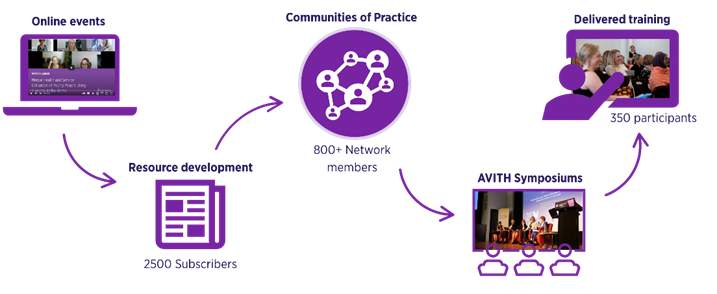
Professionals working with young people who use violence in the home play a vital role in supporting families through complex and challenging experiences. We facilitate multiple Victorian networks on this topic, and in 2025, the Centre launched the National Community of Practice, which has now grown to a network of around 150 professionals nationwide, demonstrating the importance of continuing to connect professionals across Australia to drive best practice and policy advocacy in the AVITH space. I recently had the privilege from meeting with Dr Vicky Baker about research there in the UK. As this work continues at the Centre, the team here look forward to collaborating more with international researchers.

This post has been written in Naarm (Melbourne) on land belonging to the Wurundjeri People of the Kulin Nation.

Thank you so much to Karalyn for this contribution.

References


i) Neave, M. Faulker, P. Nicholson, T. (2016) Royal Commission into Family Violence Volume IV Report and Recommendations pp. 154-155

ii) Toole-Anstey, C., Townsend, M. & Keevers, L. “I Wasn’t Gonna Quit, but by Hook or by Crook I was Gonna Find a Way Through for the Kids”: A Narrative Inquiry, of Mothers and Practitioners, Exploring the Help-seeking of Mothers’ Experiencing Child to Parent ViolenceJ Fam Viol 39, 567–579 (2024).

iii) Fitz-Gibbon, K., Meyer, S., Boxall, H., Maher, J., & Roberts, S. (2022). Adolescent family violence in Australia: A national study of prevalence, history of childhood victimisation and impacts. (Research report, 15/2022). ANROWS.

iv) Centre for Excellence in Child and Family Welfare. (2024, Dec 3.)  AVITH in Context: Exploring the lived experience of adolescent-to-mother violence [Video]. https://outcomes.org.au/event/avith-in-context-lived-experience-amv/

v) Fitz-Gibbon, K., Meyer, S., Boxall, H., Maher, J., & Roberts, S. (2022). Adolescent family violence in Australia: A national study of prevalence, history of childhood victimisation and impacts. (Research report, 15/2022). ANROWS 

vi) Campbell, E., Richter, J., Howard, J., & Cockburn, H. (2020). The PIPA project: Positive interventions for perpetrators of adolescent violence in the home (AVITH) (Research report, 04/2020). Sydney, NSW: ANROWS.

vii) Safe and Equal. (n.d.). What is family violence? https://safeandequal.org.au/understanding-family-violence/what-is-family-violence/

viii) Centre for Excellence in Child and Family Welfare. (2024, Dec 3.)  AVITH in Context: Exploring the lived experience of adolescent-to-mother violence [Video]. https://outcomes.org.au/event/avith-in-context-lived-experience-amv/

ix) Victorian Aboriginal Child and Community Agency. (n.d.). Yarn Safe. https://www.vacca.org/page/resources/family-violence-resources/yarn-safe

x) Fitz-Gibbon, K., Meyer, S., Boxall, H., Maher, J., & Roberts, S. (2022). Adolescent family violence in Australia: A national study of prevalence, history of childhood victimisation and impacts. (Research report, 15/2022). ANROWS 

xi) Centre for Excellence in Child and Family Welfare. (2024, Dec 3.)  AVITH in Context: Exploring the lived experience of adolescent-to-mother violence [Video]. https://outcomes.org.au/event/avith-in-context-lived-experience-amv/

xii) Centre for Excellence in Child and Family Welfare. (2025, Sep 18.) AVITH in Context: Substance-involved child-to-parent violence. Retrieved from https://www.youtube.com/watch?v=HTBSKcBK95w   

xiii) Harries, T., Curtis, A., Skvarc, D., Benstead, M., Walker, A., & Mayshak, R. (2024). Not all child-to-parent violence is the same: A person-based analysis using the function of aggressionFamily Relations, 73(3), 1968–1988. 

xiv) Victoria Legal Aid (2025). Feeling Supported, Not Stuck. Victoria Legal Aid.
Leave a comment

Filed under Uncategorized

Inside the Kaleidoscope

Notes from a Pedagogical Study on Child-to-Parent Violence in Italy 

The first in our international contributions comes from Italy. Specifically, Monica Facciocchi, PhD Candidate in Education in Contemporary Society. Here Monica explores her journey into Child-to-parent violence research, and the importance of international collaborations.

  1. From a radical experience deeply rooted in the folds of educational practice

I enrolled on a three-year degree course in Education Sciences because I wanted to work with children in nurseries. Without downplaying the importance of this field of work, I never thought I would have to deal with violence and families whose wounds were so deep and fresh that they were still bleeding. I first encountered the lives and stories of troubled teenagers and their families about ten years ago. Having recently graduated, I was ready to enter the world of work as a professional educator. The first services I worked in were residential communities for minors from difficult backgrounds. However, I chose to change my path because I felt I needed to listen to and welcome what often no one wants to approach: what we pretend not to see, yet which affects us all with its devastating, disruptive impact. I wanted to accompany people to see not so much the light at the end of the tunnel — nothing so salvific — but at least a possible path, a possible way forward. I approached stories as carefully as I would handle crystal, to help people see the beauty that is always hidden somewhere. 

Violence. The kind I have witnessed first-hand, felt on my own skin, and had to acknowledge in my own story and in those of others. My desire has always been to break the cycle of ill-fated, predetermined destinies and promote metamorphosis. You only see the butterfly after it has been a chrysalis. How does the saying go? ‘The flutter of a butterfly’s wings can cause a storm on the other side of the world.’ Supporting those wingbeats is what I want to do. I believe this sparked my interest in such a delicate and complex issue as the one I am about to discuss. I am not a ‘classic academic’. I never have been. I ended up doing a PhD partly because of events that happened to me, partly thanks to important people and mentors who have influenced my life, and partly because of small choices that I made over time without any grand design or great aspiration to change the world. However, I have always striven for change and transformation. The path that led me to doctoral research was challenging, a turning point and a leap into the unknown.

A few years ago in October, I was in the office of my thesis supervisor, Professor Pierangelo Barone – one of the people I could never thank enough for encouraging me to take the leap I mentioned. At one point, Alessandro Rudelli, an honorary judge at the Milan Juvenile Court – a brilliant, sensitive and humble figure, which is no small thing – entered the office and began talking about an issue he had conducted quantitative research on in court: child-to-parent violence. This marked the beginning of a collaboration between individuals and professionals who were directly involved in working with ‘difficult’ families and adolescents. When I started researching child-to-parent violence in Italy, I had no idea where this path would lead. I had encountered a form of violence towards parents by their children in the lives of the people I had worked with as an educator, but I hadn’t really dealt with it. In Italy, I found very little literature or research on the subject: just a few articles in the fields of criminology, sociology and psychology. However, as an academic in the field of education, I was struck by an absence: where was the voice of education in all this? My research essentially arose from this absence, and ultimately from a desire to restore pedagogy to its central role as a space for reflection and mediation between disciplines and translation between worlds. This would enable it to engage with the complexity of situations rather than reducing them. 

  1. The beginning of a search: points of light and areas of shadow

So I began my research. Understanding the subject was extremely difficult: there were multiple definitions, characteristics and risk factors, and few studies on how to prevent this type of violence. The first step, therefore, was to collect case files from the Juvenile Court of Milan, which had privileged access to the tortuous paths of families with violent children. After receiving approval from the court’s president, Dr Maria Carla Gatto, in the summer of 2024, I visited the court almost daily to read what are known as ‘administrative files’ in Italy. These files contain documents and reports written by various professionals, such as psychologists, social workers, educators, psychiatrists and doctors, as well as law enforcement officers. These documents aim to narrate and capture, from a specific disciplinary perspective, the turbulent journeys of families in difficulty. Particular focus is given to the re-educational dimension that characterises the interventions to be carried out with minors.

At the same time, I undertook another investigation guided by a different question: what interventions are currently being implemented in Italy to support families, parents, and adolescents experiencing these challenges? The answer lay in a single project that explicitly addressed this type of violence in Italy: the ‘Le Querce’ project, run by the ‘Gruppo Abele’ non-profit organisation. Le Querce offers psychoeducational support to parents and provides a safe apartment where they can stay when the situation at home becomes unbearable, when “home” is no longer safe, secure, familiar or habitable. Immersing myself in the project was particularly significant for me. I witnessed first-hand the suffering, the boundless love bordering on self-annihilation and the sacrifices bordering on martyrdom. Essentially, it was a moving story of pain, but above all of boundless love and lost hope. 

I wondered what the widespread perception was of a phenomenon so often confined within the family home in Italy, and what the public narrative surrounding it was. I discovered that many parents were asking for help on the online forum Quora. This forum allows anyone to ask questions of any kind, which anyone can answer. Setting aside the possibility that these questions could have been posted by fake profiles, I was struck by the hundreds of responses from the public. Many responses praised a return to violence as a method of education and blamed parents who were unable to educate their children in a way that was often harsh and stigmatising. This secondary victimisation meant that not only did parents feel guilty for not being the ‘good parents’ they had imagined themselves to be, but they were also criticised for being victims of violence. They went from being victims to being guilty of that same violence.

  1. The challenging and necessary task of narrating violence: the birth of the blog “incatrAmare”

The blog ‘incatrAmare’ was born out of a total lack of accessible, curated, filtered, valid and concrete information and content for the general public regarding the phenomenon of child-to-parent violence. I realised the need for greater dissemination of informed information through the interviews I conducted with professionals and parents as part of the ‘Le Querce’ project, as well as from the devastating lack of effective, welcoming and understanding support highlighted by comments on the Quora platform. The name ‘incatrAmare’ is made up of two Italian words: ‘tar’ and ‘love’. It is the term that a mother used in one of my interviews to describe her experience with a violent son: tarred, entangled and trapped, yet still full of love. Inspired by the content and structure of Helen Bonnick’s blog, ‘Holes in the Wall’, I decided to start this informative blog, and I am now delighted to contribute a fragment of my work and research history to it. ‘IncatrAmare’ was created to act as a bridge between academic research, work and training experiences in Italy, local scientific publications, and the wider public: parents, professionals, students, and individuals interested in understanding more about a widespread yet rarely discussed phenomenon. The blog includes a section dedicated to mapping organisations and professionals in Italy who devote part of their work to responding to child-to-parent violence in terms of training or intervention. Additionally, the site hosts research, publications, and events related to the topic within the Italian context.  One section of the blog recounts my research journey and the publications I have produced on the subject. Another section hosts articles that I have written with a popular science focus. Finally, there is an open section where anyone can contact me directly to publicise an initiative, request help or ask for further information.

  1. A glimpse into the methodology

My research gradually expanded to include various fields, such as the Milan Juvenile Court, the Le Querce project, and the online forum Quora, as well as various objects, including administrative files, interview transcripts, and Quora blog comments. These differences were reflected in the various methods used to collect data: document analysis, mediated interviews and netnography. The mediated interview is characterised as both a semi-structured interview and a process involving the use of black-and-white photographs chosen by the researcher to evoke the symbolic and unconscious dimensions of lived experiences. Netnography, on the other hand, is characterised as the systematic, interpretative and contextual analysis of conversations published by users within the questions and answers on the platform. The aim is to understand the communities that form around the topics covered, and their attitudes, values, discursive practices, motivations and social dynamics. Therefore, the research takes the form of a multiple case study in which different narratives and perspectives coexist, beginning with some common ground. First and foremost, the study’s queries: 1) How can the pedagogical perspective contribute to the theoretical understanding of child-to-parent violence? 2) What methods and tools for education can be used to support interventions in cases of child-to-parent violence, and in what way? Secondly, all the collected data is textual in nature. I have decided to conduct a thematic analysis through the lens of Bronfenbrenner’s ecological approach. I chose this approach because literature on educational and family pedagogy, as well as research into child-to-parent violence, has often used this framework successfully to understand family dynamics. This framework considers family dynamics as a whole, rather than focusing on one element, and highlights the elements that co-occur with specific phenomena within families.

  1. Research abroad: the approach of Nonviolent Resistance in Ireland

During my studies of existing interventions for cases of child-to-parent violence, I was most interested in the Nonviolent Resistance approach, which was initially developed by Professor Haim Omer. This approach involves working directly with parents to establish what the aforementioned scholar calls ‘new parental authority’ by being present for the child and resisting violent behaviour. Parental responsibility and duty should not be understood in an individualistic way, confined within the family sphere, but rather as a task that parents undertake with the support of the wider educational community. From an educational point of view, I found Professor Declan Coogan’s development of NVR training for social workers in the Irish context particularly interesting. I met Professor Coogan at a conference in Amsterdam, and I am currently at the University of Galway. I conducted research with Declan and Maria Power from the Western Region Drug and Alcohol Task Force on the strategies and learning contexts that characterise NVR training for social workers. I also had the opportunity to learn more about some of the services Ireland has developed to provide professional support to struggling parents, such as Parentline — a free, confidential helpline offering support, information and guidance on all aspects of parenting.

  1. Between the cracks: an opportunity for discussion

In the stories I have collected from courts, social centres and online posts, violence never appears as an isolated act. Rather, it is an extreme form of communication, a desperate cry for help. A child who screams, pushes and breaks things does not necessarily want to destroy; often, they simply want to be heard by a world that no longer knows how to welcome them. A parent who defends themselves, remains silent, or gives in is not just a victim; they have lost their voice and are unable to express their pain. If we understand pedagogy in its deepest sense as the art of relationships and transformation, it can help us precisely here: to interpret violence without justifying it and to give it human meaning beyond pathological or legal considerations.

In the face of such intimate and painful suffering, I believe that pedagogy should not offer immediate solutions, but spaces for thought. Pedagogy is not only the science of ‘how to do’, but ‘how to think’ – and perhaps we need the latter more today. Thinking pedagogically does not mean intervening to ‘correct’ the family, but rather accompanying it in generating meaning and significance within a broader framework. This blog is aptly titled Holes in the Wall: the walls represent silence, shame and isolation. However, it is the holes and cracks that allow us to breathe, look outside and glimpse the other. In a sense, my research seeks precisely this: gaps in the Italian discourse on child-to-parent violence. Every story, if we really listen to it, can become an opportunity for learning. Perhaps when we start to consider violence as something to be understood rather than merely endured or judged, we have already begun to transform it.

Thank you to Monica for this blog, and we are sure her reflections will be the first of many blogs from across the world demonstrating how violence must be understood, and through this understanding we can attempt to prevent it.

1 Comment

Filed under Uncategorized